Robotics raised more by June than in all of 2025. Fewer deals, bigger checks.
VCs, YC, SoftBank, Lockheed, endowments and pensions are still funding robots, drones and physical AI in 2026. The money is concentrating in fewer winners across the US, Europe and China.
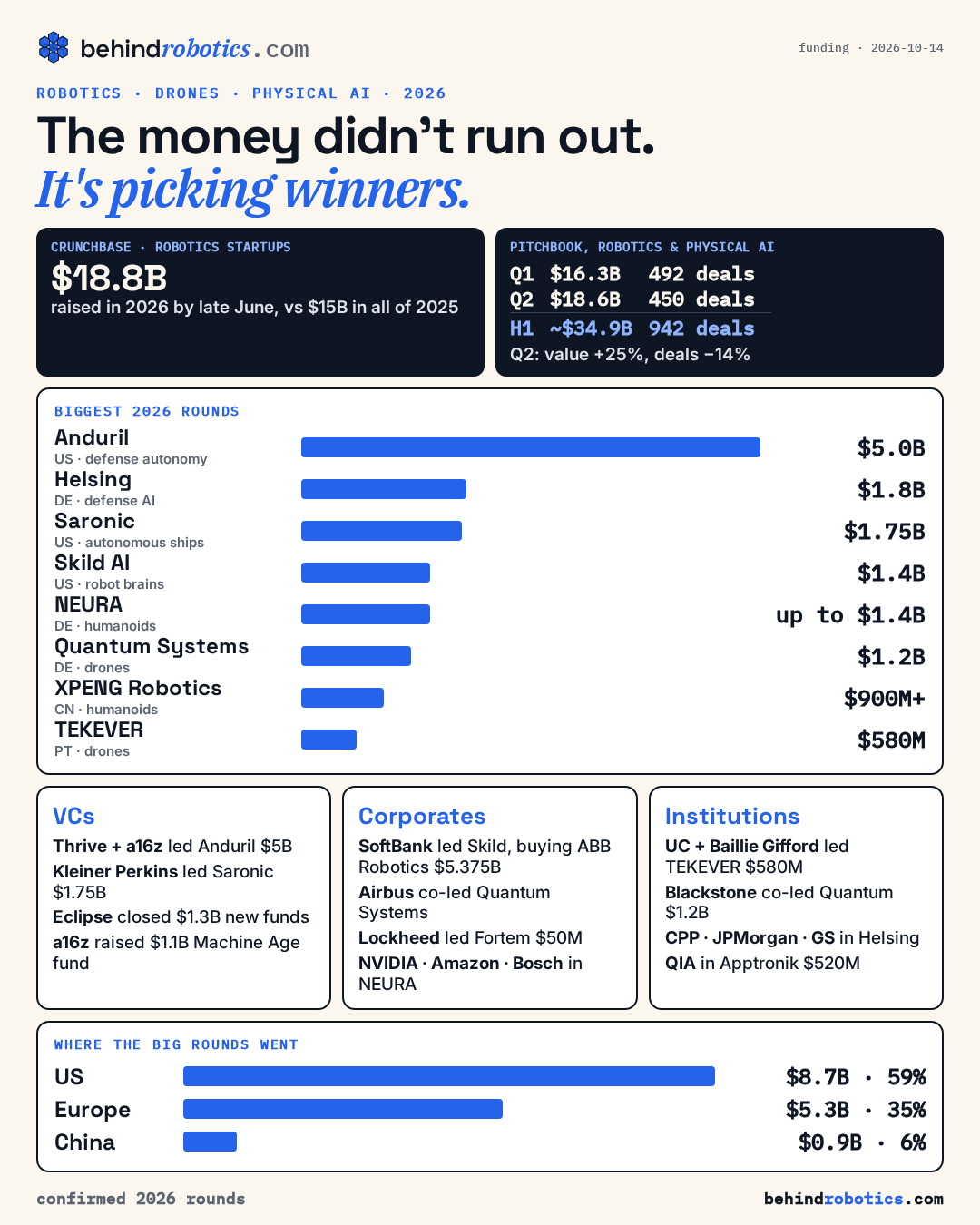
Robotics money did not dry up in 2026. It got pickier. Global robotics startups raised $18.8B in 2026 by late June, more than the $15B raised in all of 2025 and above the 2021 peak of $14.1B, according to Crunchbase. PitchBook's counts point the same way: $16.3B across 492 deals in Q1 and $18.6B across 450 deals in Q2 (Q1, Q2). Both are aggregator estimates, not audited totals.
The interesting number is the gap between those two quarters. In PitchBook's Q2 report, deal count fell 14.1% from the previous quarter while deal value rose 25.3%. The money did not leave. It piled into fewer companies that have factories, contracts and paying customers.
Added together, PitchBook's two quarters come to about $34.9B across 942 deals for the first half. That is behindrobotics' own sum of the two quarterly reports, not a figure PitchBook published, and it should not be mixed with the Crunchbase count above: the two firms define the sector differently.
What the behindrobotics database shows
The behindrobotics database now tracks 416 funding rows worth $83.0B. Of that, $39.5B sits in 333 rows dated 2026. One deal skews it: Waymo's $16B. Take Waymo out and 2026 comes to $23.5B. The concentration shows up here too. Just four rounds of $1B or more hold about half of the tracked 2026 money, while 110 rounds came in under $10M. By region, US companies account for $26.4B of the 2026 total, Europe $5.2B across 100 rounds and China $5.6B.
Two caveats. The database is built for company profiles, not market statistics. Only 19 of the 416 rows name an investor, so the investor sections below rely on company announcements and press coverage rather than our data. Some 2026 rounds, including Anduril, Helsing and Quantum Systems, are still being dated in the database, so the tracked 2026 total will rise as those updates go in.
VCs: the big funds are going all in
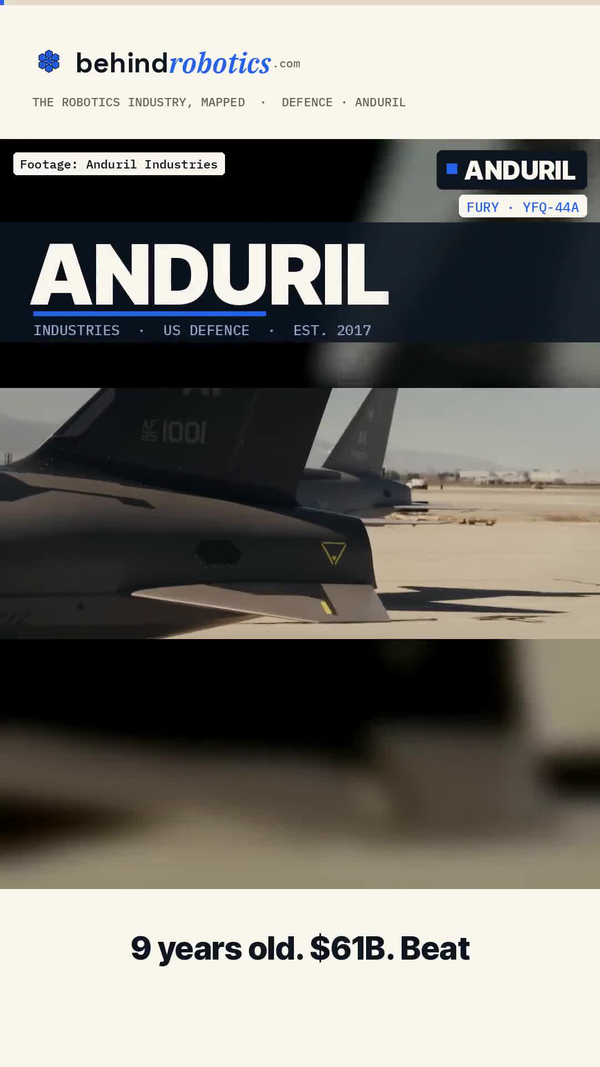
No open league table shows how much each firm puts into robotics, so behindrobotics won't make one up. What the record does show is who leads the biggest rounds. Thrive Capital and a16z co-led Anduril's $5B Series H at a $61B valuation in May. Kleiner Perkins led Saronic's $1.75B Series D at $9.25B in March. Sequoia, Lightspeed, Coatue and Felicis came back for Skild AI's ~$1.4B Series C. Crunchbase reports that Mind Robotics raised a $500M Series A (Accel and a16z) and a $400M follow-on led by Kleiner. Physical Intelligence's ~$1B round shows up in PitchBook's Q2 top deals, but behindrobotics could not find a company announcement for it.
Funds are also raising new money, not just spending what they have. Eclipse closed $1.3B across two physical-AI funds in April and now manages about $10B. a16z raised a $1.1B Machine Age Fund that covers robotics alongside chips and data centers. At the earliest stage, General Catalyst led Minerva Humanoids' ~$10M pre-seed this month.
Y Combinator: robotics at the seed stage
The early pipeline is getting deeper too. YC's Summer 2026 batch had 24 robotics startups out of 234, about 10% of the cohort and more than double any earlier batch, A3 reports. The companies range from Cosmic Robotics and Libra Robotics (autonomous construction for solar farms) to Grip Robotics (compost sorting) and Robocurve (benchmarks for robots and their models). YC's own robotics directory lists 143 companies. Getting into a batch is one thing. The hard part is the jump from a YC check to a Series A big enough to pay for hardware.
Corporates and strategics: buying, co-leading, partnering
Strategic investors are not waiting on the sidelines. SoftBank has its money in deals two ways: it led Skild's round and agreed to buy ABB Robotics for $5.375B. It is also reported to be in talks for a majority stake in 1X at about a $6B valuation, per Reuters, though no deal has been signed. Lockheed Martin led Fortem's $50M Series B in counter-drone tech. Airbus co-led Quantum Systems. NVIDIA's NVentures invested in Skild, NEURA and Figure.
Industrial companies are writing checks as well. Bosch, Schaeffler, Amazon and Qualcomm are all investors in NEURA's Series C. Google, Mercedes-Benz, John Deere and AT&T Ventures backed Apptronik's $520M A-X extension, which takes its Series A past $935M. Samsung, LG and Schneider Electric joined Skild's round. One caveat: a partnership is not an investment. Siemens works closely with robotics startups, but behindrobotics found no public equity checks.
Institutions and LPs: endowments, pensions and PE move in
This is the biggest change of 2026. UC Investments, which manages the University of California's money, co-led TEKEVER's $580M Series D at $6.4B with Baillie Gifford. The company says it is UC's first direct investment in Europe. CPP Investments, Goldman Sachs Alternatives and JPMorganChase invested in Helsing's $1.8B Series E at $18B, and Helsing says demand "significantly exceeded allocation". Blackstone co-led Quantum Systems' $1.2B Series D at about $8B, alongside Fidelity and Wellington. The European Investment Bank invested in NEURA. Checks this large used to go mostly to software companies.
Where the money goes
US: still the largest market by far. Anduril, Saronic, Skild, Apptronik and Figure (whose Series C of more than $1B at $39B closed in September 2025) set the scale. By secondary summaries of PitchBook data, Anduril alone accounted for about 27% of Q2 value.
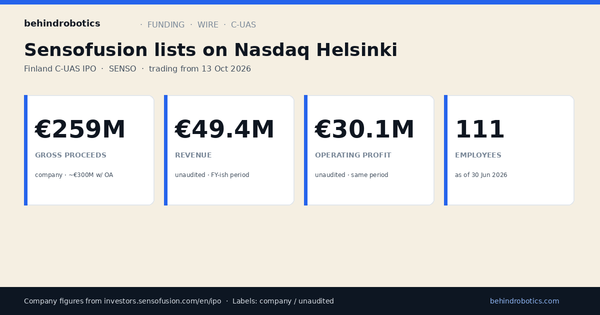
Europe: defense autonomy put Europe on the map. Helsing ($1.8B), NEURA (a round of up to $1.4B, the company says), Quantum Systems ($1.2B) and TEKEVER ($580M) all raised this year. In public markets, Finland's Sensofusion raised about €259M (~$280M) in its counter-drone IPO.
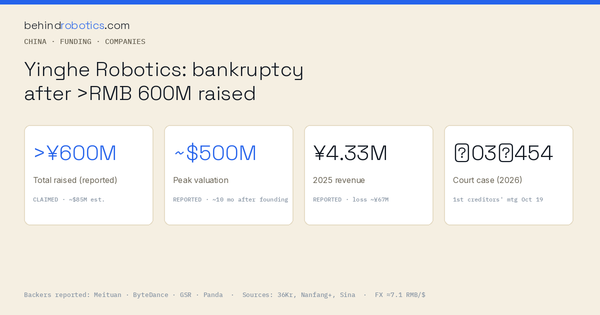
China: IDG Capital and Gaorong led XPENG Robotics' round of more than $900M at over $6.3B, with Tencent and Alibaba as strategic investors. According to Crunchbase, Shihang Intelligent raised a $1B Series A. Money is not a guarantee, though: Yinghe Robotics, once backed by Meituan and ByteDance, went into bankruptcy liquidation this year, 36Kr reports.
Gulf: Gulf money comes in mainly through syndicates. Qatar's sovereign fund, QIA, is a new investor in Apptronik's A-X. behindrobotics did not find a robotics mega-round led from the Gulf this year.
India: money is following procurement. Our sources do not show an Indian robotics or drone round on the scale above. The momentum is in field trials and defense procurement, as with the startups competing for GPS-denied drone work that behindrobotics covers. That is the market to watch for the next round of checks.
What's cooling
Investors are getting stricter. PitchBook says they now look at manufacturing scale and paying customers instead of demos. Some headline numbers also need caveats: NEURA's round is "up to" $1.4B, the Physical Intelligence round has no company announcement, and the SoftBank–1X deal is unsigned. Investors are losing patience with weak commercialization. They are not running out of capital.
The takeaway
Endowments, pensions, PE firms, defense primes and specialist funds are all still investing in robotics. The difference in 2026 is concentration: fewer deals and bigger checks, going to companies that already ship product and hold contracts. Companies still at the demo stage will find funding harder to get.