October’s biggest robot check went to a digger, not a humanoid
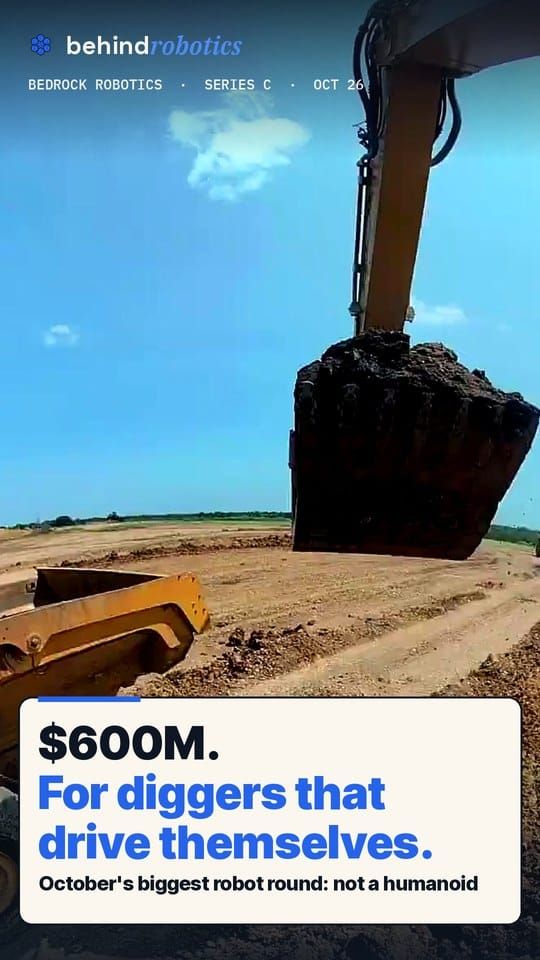
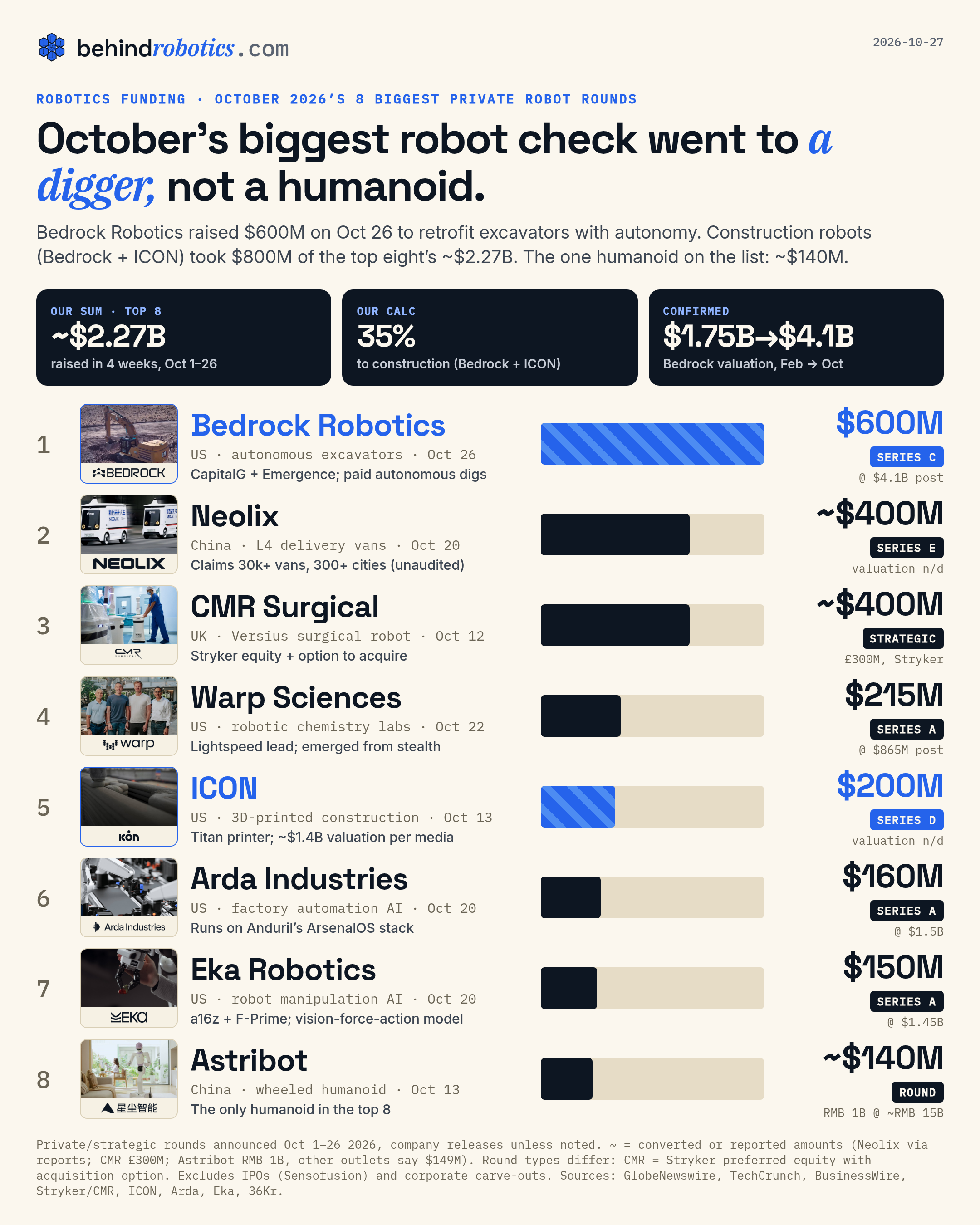
Bedrock Robotics raised $600M at $4.1B to make contractors’ existing excavators dig on their own, up from $1.75B in February. It tops October’s eight biggest robot rounds (~$2.27B). Construction took 35%; the one humanoid, about 6%.
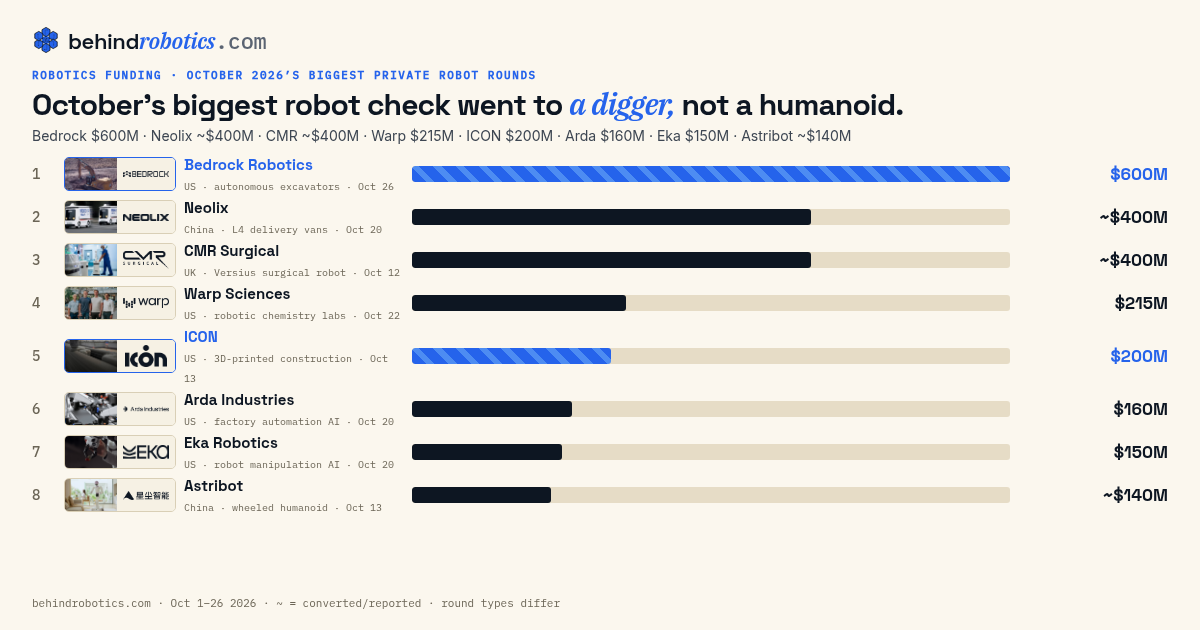
On October 26, 2026, Bedrock Robotics raised $600M in a Series C at a $4.1B post-money valuation, co-led by CapitalG and Emergence Capital. Bedrock does not build robots. It fits a kit to excavators contractors already own, and since mid-August those machines have done paid, fully autonomous work on live job sites. It is the largest private robotics round of the month on our tracker. The only humanoid in October’s top eight raised about a quarter as much.
- The round: $600M Series C at $4.1B post-money. New investors are USIT, Bessemer and Temasek. Existing backers include 8VC, Valor, Eclipse and NVIDIA. Total raised: “nearly $1 billion” (company).
- The jump: Bedrock was valued at $1.75B in its $270M Series B on Feb 4, 2026. That is about 2.3× in under nine months (our calc).
- The proof point: autonomous excavators are working commercially at a Nevada water treatment facility, a Champion Site Prep earthwork site in Texas, and a 1.2M-cubic-yard Zachry civil sitework project (TechCrunch).
- The pull: construction can’t hire. 87% of firms report open craft roles. ABC estimates more than 40% of construction workers retire within five years. Bedrock says an operator needs 5+ years to master an excavator.
- The month: the eight biggest private robot rounds we tracked from Oct 1 to Oct 26 total about $2.27B. Construction (Bedrock + ICON) took $800M of that, or 35%. Humanoids (Astribot) took about $140M, or 6% (our calc).
$600M for a kit, not a machine
Bedrock’s announcement says the round was co-led by CapitalG and Emergence Capital. New money came from the US Innovative Technology Fund, Bessemer Venture Partners and Temasek. Existing investors 8VC, Georgian, Valor Equity Partners, Xora, Eclipse, Perry Creek Capital and NVIDIA also joined. Founded in 2024 by Waymo veterans, Bedrock came out of stealth in July 2025. In February 2026 it raised a $270M Series B at $1.75B. CEO Boris Sofman previously ran Waymo’s self-driving truck programme and co-founded Anki.
The product is a retrofit. Bedrock fits sensors and compute to excavators contractors already own, rather than selling a new machine. That keeps the contractor’s fleet, dealer and service network in place. Our reading: that is why the business can scale faster than a hardware start-up building its own iron.
Paid digs, not demos
Bedrock says that in mid-August 2026 its excavators began doing “paid work on live commercial job sites” fully autonomously. TechCrunch names three: a water treatment facility in Nevada, an earthwork site run by Champion Site Prep in Texas, and a 1.2-million-cubic-yard civil sitework project with Zachry Construction.
The newest partner is Haydon, a 100% employee-owned general contractor based in Tempe, Arizona. It will use Bedrock for fully autonomous earthwork on a remote Texas site, then test trench work and larger machines. New customers listed in the release: Wagner Construction (MN), Smith Trucking (FL), B&S Site Development (VA), Native Excavating (CO), Clarkson Construction (MO), C.W. Matthews (GA) and ArchKey Solutions projects (AR). Bedrock says customer volume has “more than doubled” since 2025. It does not disclose machine counts, hours or revenue.
The labour gap is the sales pitch
Bedrock cites about 1.7 million skilled-trades openings a year in the US through 2035. In construction, 87% of firms report open hourly craft positions, and 88% say they are as hard or harder to fill than a year ago. TechCrunch adds the Associated Builders and Contractors estimate that more than 40% of construction workers will retire within five years. Bedrock says it takes five years or more to master an excavator. “For us, the biggest win is a safer, more predictable job site,” said Haydon CEO Katie Haydon.
October’s robot money went to dirt, vans and labs
Bedrock tops the eight largest private robotics rounds we tracked from October 1 to 26. Next come Neolix (~$400M Series E for L4 delivery vans, TechNode) and CMR Surgical, where Stryker is putting in ~$400M (£300M) of preferred equity with an exclusive option to buy the whole company. The rest: Warp Sciences ($215M Series A at $865M, robotic chemistry labs), ICON ($200M Series D, 3D-printed construction), Arda ($160M at $1.5B, factory automation), Eka ($150M at $1.45B, robot manipulation AI) and Astribot (RMB 1B, about $140M, at a reported RMB 15B).
That totals about $2.27B. Construction (Bedrock + ICON) is $800M, about 35%. The one humanoid maker on the list, Astribot, is about 6% (both our calc). One month is a small sample. Our reading: investors are paying up where robots already earn money on existing equipment and workflows, not where the hardware is newest.
Four signals
- A first hard number from Bedrock: autonomous machine count, operating hours or cubic yards moved.
- Haydon’s trench work and larger machines moving from test to paid work.
- Whether OEMs such as Caterpillar or Komatsu partner, compete or buy in this category.
- Whether November rounds keep favouring retrofit autonomy over new humanoid hardware.
Sources
- Bedrock Robotics, Series C release (Oct 26 2026): globenewswire.com
- TechCrunch, “This startup’s self-driving excavators help dig up $600M in new funding” (Oct 26 2026): techcrunch.com
- Bedrock Robotics, Series B release, $270M at $1.75B (Feb 4 2026): prnewswire.com
- TechNode, Neolix nearly $400M Series E (Oct 20 2026): technode.com
- Stryker / CMR Surgical strategic alliance (Oct 12 2026): stryker.com
- Warp Sciences, $215M (Oct 22 2026): businesswire.com; valuation via TechCrunch
- ICON, $200M Series D (Oct 13 2026): globenewswire.com
- Arda, emerges from stealth (Oct 20 2026): businesswire.com
- TechCrunch, Eka worth $1.45B (Oct 20 2026): techcrunch.com
- EqualOcean, Astribot RMB 1B at reported RMB 15B (Oct 14 2026): equalocean.com