Data, Drama, Entertainment - Clarkson’s Farm: the demographic change, farm robots, cost and policy. Could humanoid farmhands be the answer?
How Clarkson accidentally sold Britain on robot farming
In Clarkson's Farm Season 5, a health scare and a budget crisis pushed Jeremy Clarkson toward automation — a Dutch driverless tractor, a Danish seeding robot, and a trip to the hyper-automated farms of the Netherlands. Here's what he used, the real science behind it, and why an ageing, short-staffed farming world may have no choice but to follow.
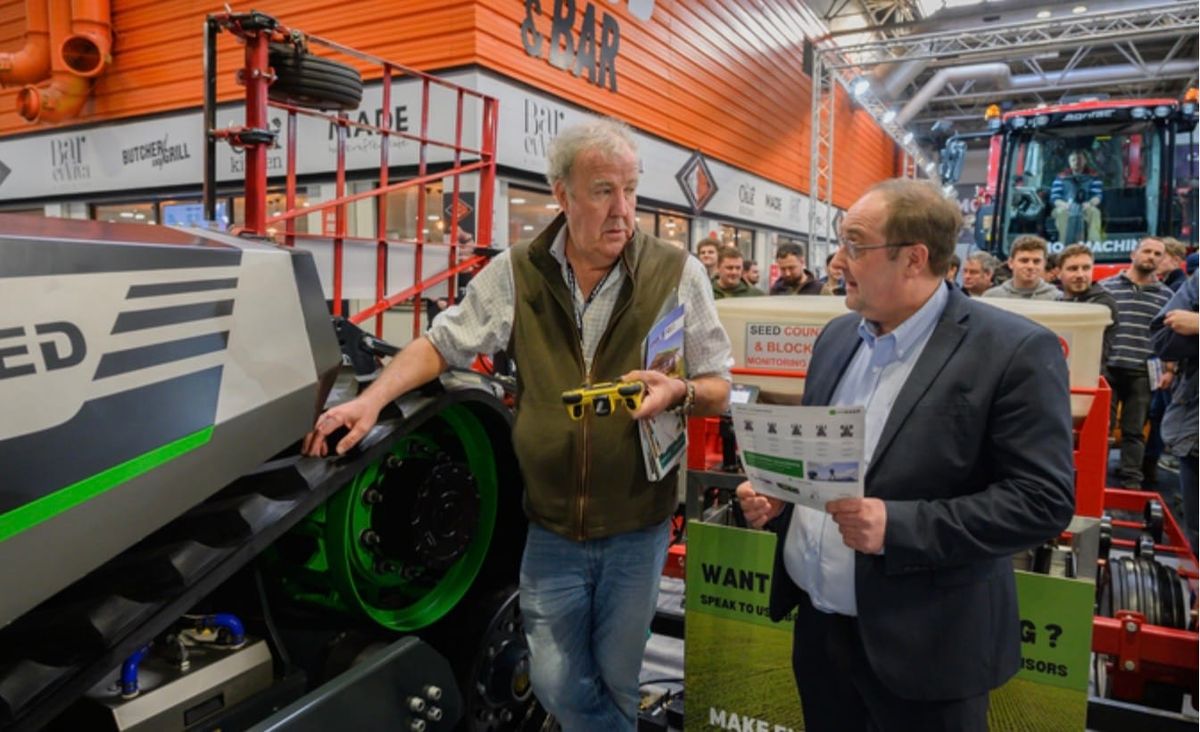
Jeremy Clarkson spent four seasons being yelled at by his young farmhand Kaleb Cooper for doing farm jobs badly. In Season 5 — released on Prime Video in late May 2026 — he found a way to do them without doing them at all. The autonomous-farming storyline runs across the season and comes to a head in Episode 6, "Frazzling," when the AgBot driverless tractor arrives and the ageing "green Lambo" is sold off. In doing so, Clarkson gave autonomous agriculture its biggest mainstream showcase yet.
Watch: the moments that matter
01The machines he used — and their makers
Each company's own channel, where the product is introduced
Two machines star in the automation arc, both European. Clarkson leased an AgXeed AgBot (Dutch, sold to him on the show by AS Communications) to cultivate and drill his fields, and first encountered the FarmDroid FD20 (Danish, solar-powered) at the LAMMA farm-machinery show. The "computer terminal" he fretted over at home is the AgXeed cloud portal — the planning-and-monitoring dashboard every AgBot connects to.
The two robots on Diddly Squat
AgXeed AgBot T2 — a driverless, diesel-electric tracked tractor from the Netherlands. Positions to 2.5cm, runs unsupervised nearly round-the-clock, and — in Clarkson's words — "doesn't need to stop for a wee and it does not need to sleep." Its makers demo it best on their own channel. [1][3]
FarmDroid FD20 — a Danish solar-powered robot that seeds and mechanically weeds, recording every seed's position for chemical-free intra-row weeding at 8mm accuracy. Runs 18–24 hours on solar; covers up to 6 ha/day. [4]
▶ Official channels — AgXeed: youtube.com/@agxeed · a good intro is "Can this robot tractor solve farming's labour crisis?". FarmDroid: FarmDroid FD20 demos. Both companies' full profiles, prices and links are in the database below.
02The real science: what precision farming actually does
Verified figures from peer-reviewed studies and EU research — not marketing
The magic isn't the driving — it's the data map underneath and the plant-by-plant precision on top. Autonomous machines treat a field not as one block but as a grid of hundreds of micro-zones, each with its own moisture, yield potential and input needs. That's a real, established practice — yield maps, satellite NDVI, and variable-rate prescription maps are decades-old agronomy, now made cheap by robotics. And the environmental numbers are genuinely large:
On the efficiency side: AgXeed reports customers save up to 90% on labour and cut total operating costs 25–35% versus conventional tractors, with lighter machines meaning less soil compaction (the AgBot T2 exerts just 0.3 bar ground pressure). FarmDroid's seed-position mapping enables chemical-free weeding entirely. And the EU's own research network (via Wageningen and the CAP innovation programme) is validating up to 95% plant-protection savings across pilot farms. [1][6][7]
Interactive — switch the layer, tap a cell to read the value and what a robot would do differently
03Why the timing is not a coincidence: farming is greying fast
The demographic squeeze that makes robots a structural necessity, not a gadget
Clarkson framed automation as a personal fix for a body that could no longer take the farm's punishment. But his personal problem is the whole industry's problem. Across Europe and the US, farmers are old, getting older, and not being replaced — while the labour that props up harvests is drying up.
Europe: only 1 in 17 farmers is under 35
USA benchmark: average farmer age 58.1
Layer on the labour crisis: harvests across Europe and the US lean heavily on migrant and seasonal workers, and immigration crackdowns plus Brexit have thinned that pool sharply. AgXeed markets the AgBot squarely at this — its own headline is literally "Can this robot tractor solve farming's labour crisis?" When you can't find people to sit in the cab for 14-hour days, a machine that runs 24/7 without a driver stops being a luxury and becomes the only way the harvest happens. [1]
The "Clarkson effect": did one episode move a whole industry?
When a show watched in 240+ countries puts a farm robot on screen, the makers notice. Here's what's documented around the Season 5 air date — and an honest note on what isn't.
Before & after the FarmDroid / AgBot episode aired
"Having our robot featured in an internationally successful series like Clarkson's Farm shows that autonomous field robotics is no longer a technology of the future."
— Kristian Vest Warming, CEO of FarmDroid, on air date (11 Jun 2026) [14]So did Jeremy Clarkson single-handedly save farming? No — the demographic and labour pressures were already forcing the shift. But by putting a Danish seeding robot and a Dutch driverless tractor in front of a global audience, at the exact moment the industry needed new entrants and buyers to believe, he may have accidentally done more for autonomous agriculture's mainstream credibility than a decade of trade-show demos — and not just in the UK. When FarmDroid's CEO says the tech is "no longer a technology of the future," that sentence is the Clarkson effect in words.
04Who's actually adopting — and the family-farm lifeline
Corporate scale, drones, and a route to keep multi-generational farms alive
Large-scale European adoption is real but uneven. The clearest movers are the Dutch precision-farming pioneers — the show's own Netherlands trip visited Jacob van den Borne, a potato farmer whose operation is a global reference case for data-driven farming. On the aerial side, agricultural drones from XAG and DJI (Agras) are scaling fast: the European ag-drone market was ~$7.5B in 2025, growing ~28% a year, used for spraying, multispectral mapping and crop scouting. Big machinery groups — CLAAS (an AgXeed investor), John Deere, and AGCO/Fendt — are folding autonomy into their fleets. [10][11]
How automation can preserve the family farm
It replaces labour you can't hire. A multi-generational farm that can't find (or afford) farmhands can keep operating with one person supervising several machines — the difference between carrying on and selling up.
It makes succession attractive. Young would-be successors want to run a modern, data-driven, less back-breaking business — not repeat their grandparents' 5am grind. Automation is what keeps the next generation interested.
It lets small farms punch above their size. Shared-equipment cooperatives and contractor models put €300k robots within reach of farms too small to buy alone — pooling capital to compete with agribusiness.
05What's holding it back — and how governments are pushing
Cost, culture, regulation — and the subsidies trying to break the logjam
If the case is so strong, why isn't every field robotic? Five real barriers:
Beyond cost: regulation (many countries still restrict driverless machines on public roads — though Germany's 2024 Road Traffic Act now allows them on private land and designated rural routes), rural broadband gaps that break cloud-connected autonomy, repair and support deserts far from dealers, and a real cultural divide — the Kaleb Cooper instinct that a robot can't read a field like a person who's farmed it for 30 years. Trust is generational, and it's earned slowly.
Government support: the subsidy picture
This is where policy is actively tipping the scales, especially in the EU:
Who pays to help you automate
EU Common Agricultural Policy (CAP): over €38B/year in eco-schemes reward precision and digital farming; CAP eco-schemes can reimburse up to 40% of qualifying equipment. [6][7]
National schemes: France and Denmark launched subsidies covering up to 40% of the capital cost of robotic weeders and autonomous sprayers. The UK ran the Farming Equipment & Technology Fund (FETF) for precision kit. [6]
The policy pull: the EU Green Deal / Farm-to-Fork targets a 50% pesticide cut and 20% less fertiliser by 2030 — binding pressure that makes precision equipment less optional every year. [7]
Culturally, willingness is rising fastest where the squeeze is hardest — big arable estates facing labour shortages adopt first, while smaller and older operations wait for proof, financing, and a neighbour who went first. The direction is one-way, but the speed varies enormously by country, farm size, and generation.
06The robot-farming field guide
Tap any company for founders, funding, products & prices — gold = featured on Clarkson's Farm
Every company referenced above, in one database. Tap a card to expand its full profile and links.
↑ tap any company to expand · prices are approximate list/quote figures
Clarkson set out to solve a personal problem and stumbled onto the industry's defining one. The machines (Dutch AgBot, Danish FarmDroid) are real, deployed, and precise to the centimetre; the science on chemical and labour savings is genuine and large. With a third of European farmers past retirement age and no one to replace them, robot-supported farming isn't the future of agriculture — it's fast becoming the only way it survives.
Sources & further reading
Heatmap is illustrative on realistic ranges. Company/pricing details from public sources on the dates shown and vary by configuration/quote. Not investment or agronomic advice.