Featured & Interactive - Actuators decide the robot race
The joint problem: who really controls the robotics race
The winner won't be decided by the smartest AI. It'll be decided by whoever controls the tiny, backlash-free gears that let a robot bend its arm — and those gears are quietly becoming a strategic weapon.
How the joint works
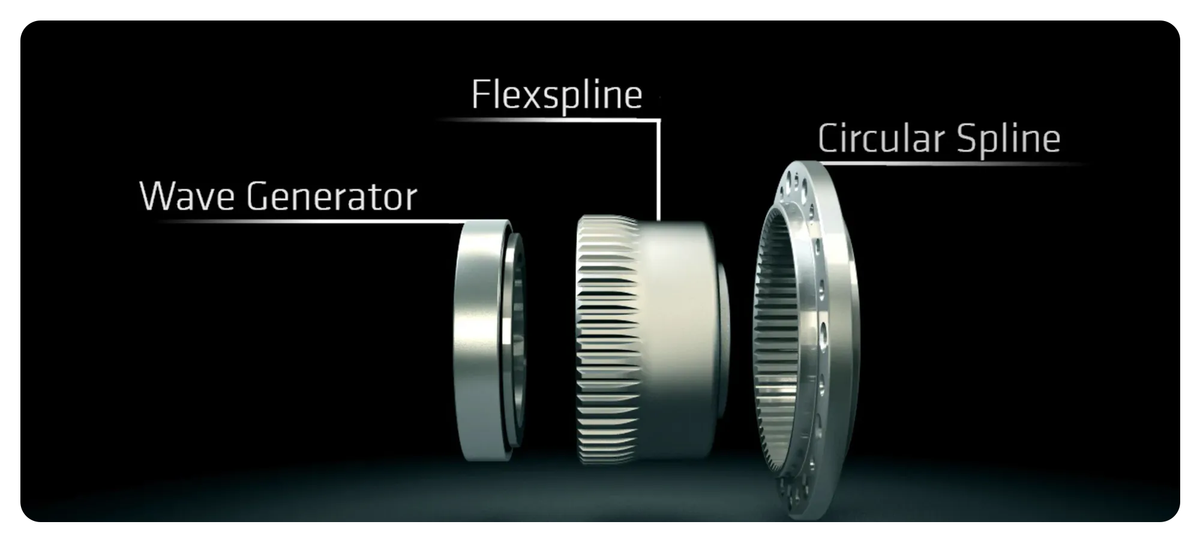
The blue ellipse (the input) spins fast, flexing the orange steel cup so its teeth mesh with the grey outer ring at just two points — the orange zones. Because the ring has 2 more teeth than the cup, each full input turn nudges the output backward by only 2 teeth: a 100:1 reduction with essentially zero backlash.
Everyone watching the robotics boom is staring at the wrong layer. The headlines go to AI models, simulation, and slick humanoid demos. But the contest over who actually builds the physical workforce of the next few decades is a factory-floor brawl over three unglamorous things: how fast you can iterate hardware, how many units you can ship, and whether your supply chain survives when the world gets tense.
It all funnels down to the component you just watched spin: the precision gear reducer — the "joint" that turns a fast, weak motor spin into slow, powerful, precise movement. Get these wrong and your robot is jerky, weak, or dead. Whoever controls them holds leverage over the entire stack.
◐ The 30-second physics
A harmonic (strain-wave) drive — the one animated above — flexes a thin steel cup with an elliptical wave generator so its teeth mesh with an outer ring at two points. The result: huge reduction ratios in a tiny, light package with essentially no play. Perfect for wrists and elbows.
A cycloidal / RV reducer is the muscle — it takes the heavy torque at shoulders and base. Between them, these two families are the joints of every serious robot. A humanoid needs dozens per unit.
That last point is why this matters now. An industrial arm needs a handful of reducers. A humanoid needs a joint at every knuckle, wrist, elbow, shoulder, hip, knee and ankle. Multiply that by the volumes Tesla, Unitree, UBTech and Figure are promising and a niche precision part becomes a strategic chokepoint overnight. Global humanoid shipments already jumped nearly fivefold in 2025 — one forecast puts them at 2.6 million units a year by 2035.
01Three poles, one bottleneck
Where each region actually stands — tap to switch
Japan still sets the quality bar and sits quietly atop the premium market. But the strategic contest is a three-way fight: China's volume, America's software, and Europe's precision. Here's the honest scorecard.
02Who owns the market
Approximate share of global harmonic (strain-wave) revenue, 2025
Sources disagree — a lot — because "harmonic market" gets defined differently each time. But the consistent shape is two dominant names atop a long, fragmented tail. The two leaders, Harmonic Drive Systems and Leaderdrive, together hold roughly 40–45% of global harmonic revenue; the rest splits across dozens of mostly-Chinese makers and a thin Western slice [1][2][6][14].
Pick a country to break its slice into the actual companies behind it — with each one's share, revenue and rough unit volume.
Two things explain the "where's the other half?" question. First, no single player dominates the way you'd expect — outside the top two, the market is a swarm of Chinese specialists each holding low-single-digit share. Second, harmonic is only half the joint story: on the heavy-torque RV / cycloidal side, Nabtesco alone reports ~60% of the medium-to-large industrial-robot segment [3]. The West mostly buys its joints from Japan or, increasingly, China.
03The players, by the numbers
Founding · funding & investors · founders · revenue · reducer exposure
These are the names that recur across filings and market reports. Financials are the latest available (mostly FY2025); "reducer revenue" is the actuator/precision-reducer slice where a company is diversified. Figures are approximate and move fast with the humanoid cycle.
Also circling: Sumitomo Heavy Industries (JP), THK & Hiwin (JP/TW), Neugart & maxon (EU), GAM (US), BENRUN (DK), plus Korean specialists. Automation giants — Siemens, Yaskawa, ABB, Fanuc, Estun — mostly integrate or co-develop actuators rather than specialise in the reducer itself.
The dual-use trap
Why the joints could become the next export-control battleground
Here's the uncomfortable part. The same reducer that swings a factory arm can swing a weapons platform. Precision actuators are dual-use by nature — and so far they've escaped the intensity of controls now smothering advanced chips and lithography.
That's unlikely to last. The EU's 2025 dual-use list added a new "500 series" for emerging technologies outside the old multilateral consensus [10][11], and China revamped its own dual-use regulations and critical-mineral controls in late 2024–2025 [12][13]. The semiconductor precedent shows how fast a "commercial" part gets reclassified once national-security arguments take hold — and 2025 US tariffs already hit precision assemblies across the reducer supply chain [9].
The takeaway: companies and countries investing now in diversified, resilient, allied-source actuator capacity will be positioned to win. Treat reducers as a commodity and you may discover — too late — that the joints of the robot economy have quietly become licensable strategic assets.
Speed of iteration, manufacturing scale, and control of the actuator supply chain will decide who builds the physical workforce of the future. Harmonic and precision drives sit at the intersection of all three. The winners won't treat actuators as a part they buy — they'll treat them as a capability they own.
Sources & further reading
Public filings, company disclosures, market research and regulatory texts consulted for this piece.
Financial figures are approximate, drawn from public filings and market reports (2025–26) and will shift with the humanoid cycle. Reducer-revenue splits are Robot Hive estimates where companies do not break out the segment. Analysis, not investment advice.