India plans $15B of military drones. Its biggest signed kamikaze order is 540
India plans more than ₹1.5 lakh crore (>$15B) of drones over five years. Its biggest signed loiter-munition order covers 540 munitions. Russia's Alabuga plant builds 36,000+ a year. A retired general calls it buying in 'penny packets'.
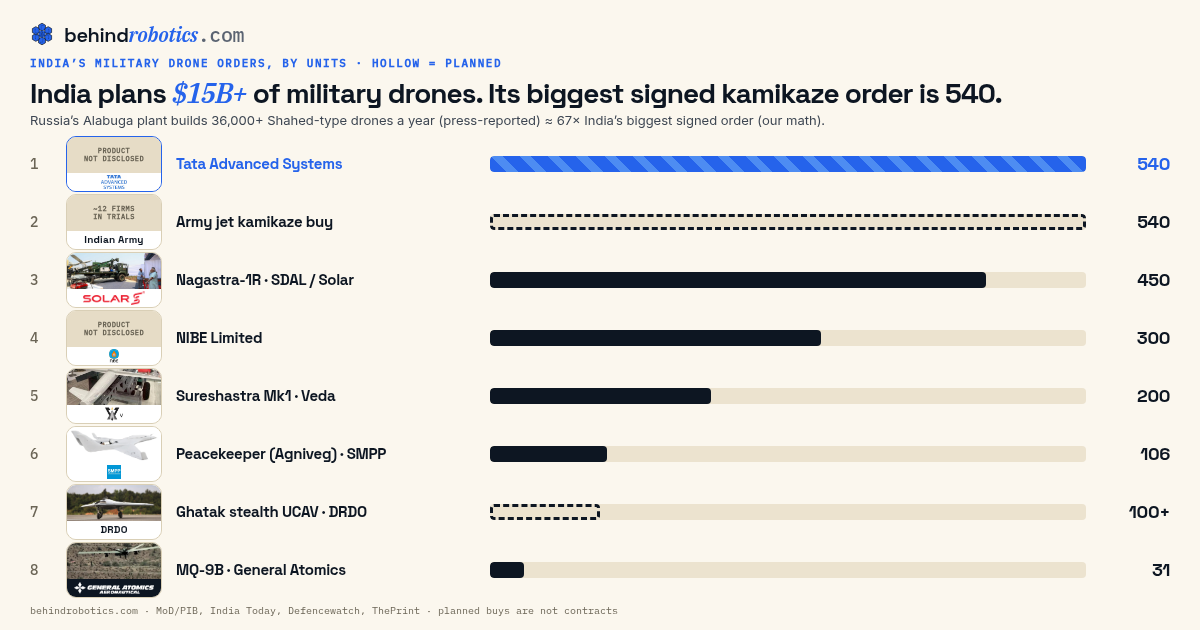
India says it will spend more than ₹1.5 lakh crore (over $15B) on drones across its three services over five years, India Today reported on Oct 30. The orders actually signed tell a smaller story. The biggest loiter-munition contract to date covers 540 munitions. Russia's Alabuga plant alone builds 36,000+ Shahed-type drones a year. A retired general's word for India's approach: "penny packets."
- The plan: over ₹1.5 lakh crore (>$15B) of drones across the Army, Navy and Air Force over five years (India Today, Oct 30 2026).
- The biggest signed order: on Aug 14 2026 the Ministry of Defence signed ₹1,577 crore with Tata Advanced Systems (540 munitions, 54 systems) and NIBE (300 munitions, 30 systems) for loiter munitions with up to 100 km range (MoD via The Hindu/PIB).
- The pipeline: on Oct 26 the Defence Acquisition Council approved ₹2.12 lakh crore of proposals. Six of the Army's ten items are drones, counter-drone or air defence. That approval is a first step, not a contract.
- The gap: one Russian plant's yearly output is about 67× India's biggest signed loiter-munition order (our math: 36,000 ÷ 540).
₹1.5 lakh crore on paper
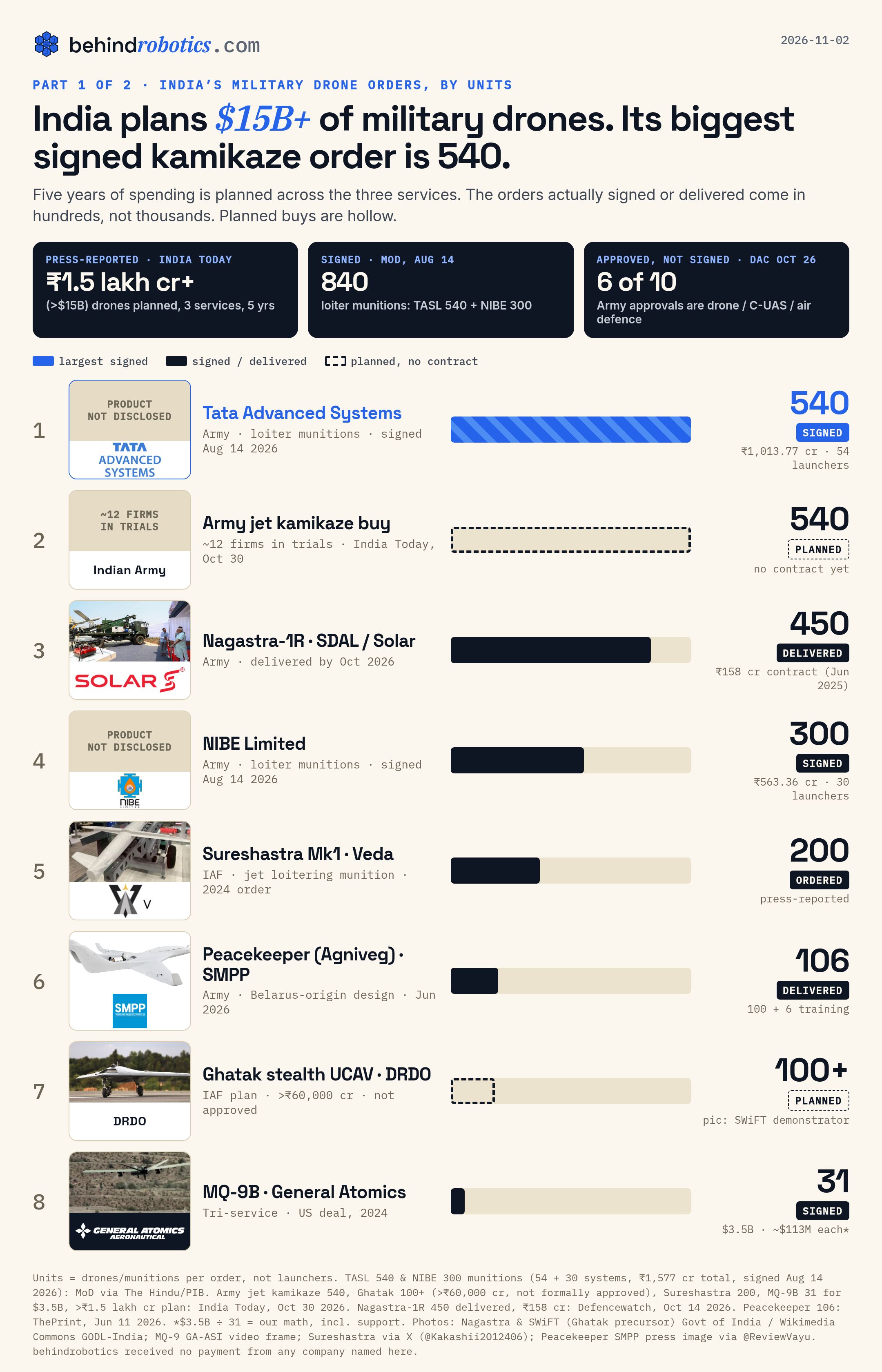
India Today's Sandeep Unnithan tallied the drone plans of all three services at more than ₹1.5 lakh crore over five years. The list is long: 31 MQ-9B drones from General Atomics for about $3.5B (signed 2024), a planned fleet of 100+ Ghatak stealth combat drones worth over ₹60,000 crore (not yet formally approved), and Army trials of jet-powered kamikaze drones from about a dozen firms, with a hoped-for buy of 540. The Army also plans to train 100,000+ drone operators across 385 battalions.
The pipeline got bigger on Oct 26. The Defence Acquisition Council gave Acceptance of Necessity to ₹2.12 lakh crore of proposals, about 82% of it to be sourced from Indian industry (New Indian Express, PIB). Six of the Army's ten approvals were drones, counter-drone or air defence: long-range UAS, surveillance UAVs, an integrated surveillance-and-strike system, a long-range kamikaze drone system, VSHORADS and platform-mounted counter-drone kits for tanks. An AoN is permission to start buying. Contracts can take years.
Signed in hundreds, not thousands
The largest signed loiter-munition deal is the ₹1,577 crore pair of contracts the MoD signed on Aug 14 2026 under the fast-track procedure (The Hindu). Tata Advanced Systems, the L-1 bidder, gets ₹1,013.77 crore for 54 systems and 540 munitions. NIBE, L-2, gets ₹563.36 crore for 30 systems and 300 munitions. Range is up to 100 km, indigenous content is 60%, and delivery is due within 12 months of the advance payment. Neither company has named the product publicly. Our math: TASL's contract works out to about ₹1.88 crore per munition, launchers and accessories included.
The other numbers are smaller. Solar Defence and Aerospace delivered 450 Nagastra-1R loitering munitions to the Army on a ₹158 crore contract placed in June 2025 (Defencewatch, Oct 14 2026). Our math: about ₹35 lakh each. The IAF ordered 200 Sureshastra jet loitering munitions from Veda Aeronautics in 2024 (India Today). SMPP delivered 106 Peacekeeper (Agniveg) jet kamikaze drones, 100 operational and 6 for training, a design that ThePrint reports comes from Belarus's KB Indela (ThePrint, Jun 11 2026).
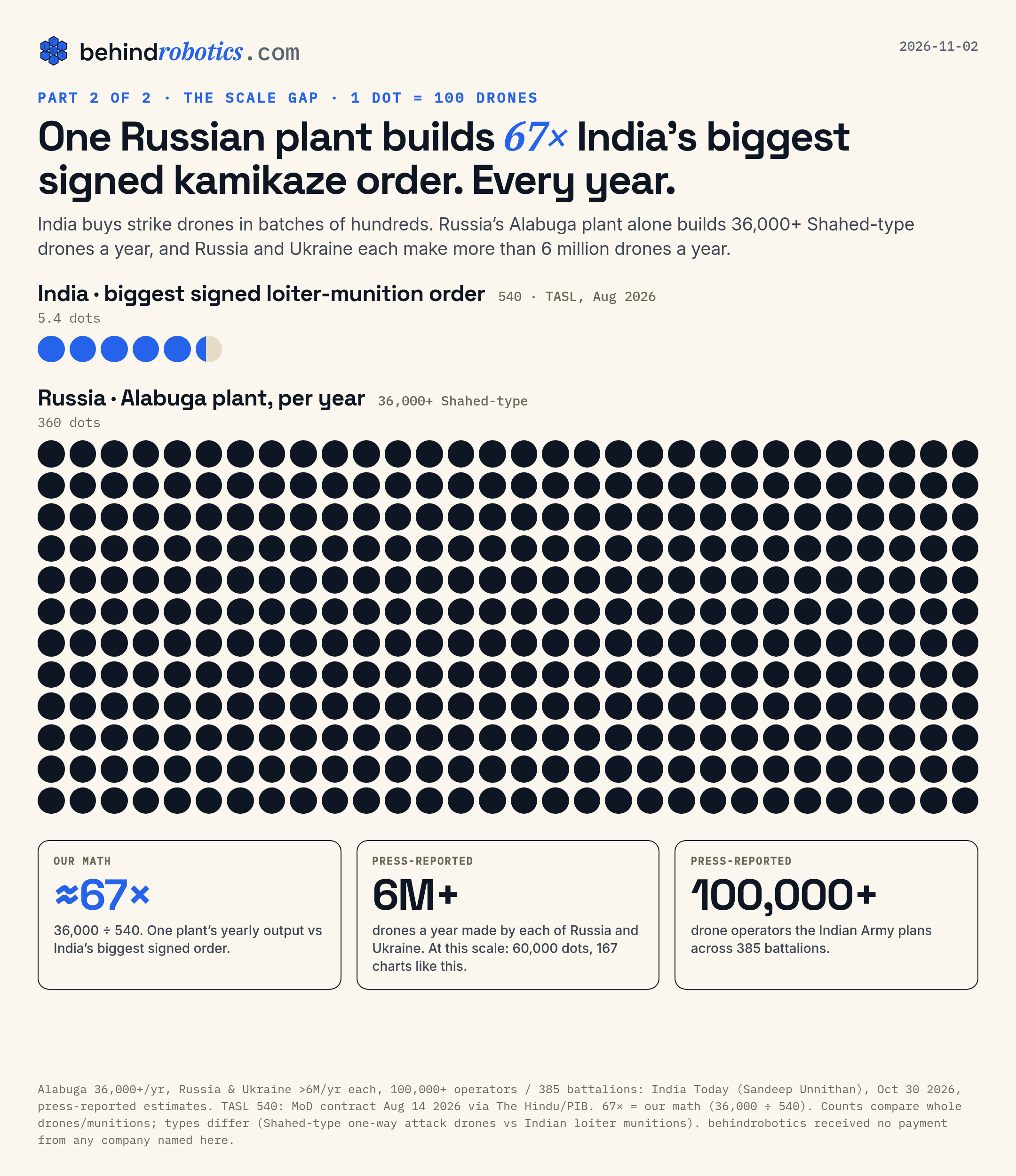
Russia counts drones by the factory
India Today cites Russia's Alabuga plant at 36,000+ Shahed-type drones a year, and Russia and Ukraine at more than 6 million drones a year each. Those are press-reported estimates, and the types differ: Shaheds are cheap one-way attack drones, not the sensor-heavy loiter munitions on India's list. The article contrasts a roughly $50,000 Filin drone with a $2M Tomahawk. Even so, the scale is hard to ignore. Our math: Alabuga's yearly output is about 67× India's biggest signed loiter-munition order.
Lt Gen PR Shankar (retd), quoted by India Today, called the approach "penny packets": small batches spread across many vendors and programmes. The article also points to the supply chain. India has 600+ drone makers, China holds more than 80% of the global market, a small drone needs 100+ chips and an MQ-9B more than 1,000.
Five signals
- Whether the Army's jet kamikaze trials turn into a signed contract, and whether it is for 540 or for thousands.
- Which of the Oct 26 AoNs reach contract signature within 12 months.
- Whether TASL and NIBE deliver within 12 months of the advance payment.
- Whether the CCS formally approves Ghatak.
- Whether repeat orders go to one or two vendors at volume, or keep getting split.
Sources
- India Today (Sandeep Unnithan), India's drone arsenal: production, technology and doctrine gaps (Oct 30 2026): indiatoday.in
- The Hindu, TASL, NIBE bag ₹1,577 crore Army contracts for loiter munitions (Aug 15 2026): thehindu.com · PIB release (MoD)
- New Indian Express, Kamikaze drones, more K9 Vajras: Centre okays arms buys worth ₹2.12 lakh crore (Oct 26 2026): newindianexpress.com · PIB PRID 2328486
- Defencewatch, SDAL delivers 450 Nagastra-1R to the Indian Army (Oct 14 2026): defencewatch.in · Times of India (Oct 2026)
- ThePrint, SMPP delivers 106 Peacekeeper (Agniveg) jet kamikaze drones (Jun 11 2026): theprint.in
- Economic Times, CBI arrests Munitions India executive director, SMPP CEO in ₹500 crore defence deal bribery case (Oct 2026): economictimes.com
- Photos: Nagastra and DRDO SWiFT, Government of India via Wikimedia Commons (GODL-India); MQ-9 frame from GA-ASI official video on X; Sureshastra photo via X (@Kakashii2O12406); Peacekeeper press image via @ReviewVayu on X.