Inventor Palmer Luckey: from oculus VR to “neoprime”. This is Anduril Industries

The unfair fight
A homeschooled VR prodigy sold Oculus at 21, was pushed out of Facebook at 24, and then built a $61-billion defense company, a national bank, and an arsenal that spans air, sea, land and spectrum. This is how Palmer Luckey rewrote the rules of American defense — and what he's building next.

There is a red phone on Palmer Luckey's desk in Costa Mesa — a genuine relic of the US nuclear command network. He acquired it back when he was still just the kid who built the Oculus Rift in a trailer and then got pushed out of Facebook over a political donation. At some point it stopped being memorabilia and became a thesis. Nine years later that thesis is Anduril Industries: a company that has taken production contracts off Lockheed, Boeing and Raytheon, and whose founder — still in his early thirties — has become the most consequential new inventor-operator in American defense.
(from $8.5B in 2023)
(roughly 2× 2024)
Costa Mesa, CA
Palmer Freeman Luckey
Born 1992, Long Beach. Homeschooled. Self-taught hardware hacker. Sold his first company at 21.

Palmer Freeman Luckey
Homeschooled in Long Beach, California; built and modded electronics as a teenager and prototyped the headset that became the Oculus Rift in his parents' trailer. Sold Oculus to Facebook in 2014 for about $2 billion at age 21. Left Facebook in 2017 and founded Anduril the same year with four Palantir alumni. He is a hardware inventor who became a company builder — not a career defense executive, which is precisely the point.
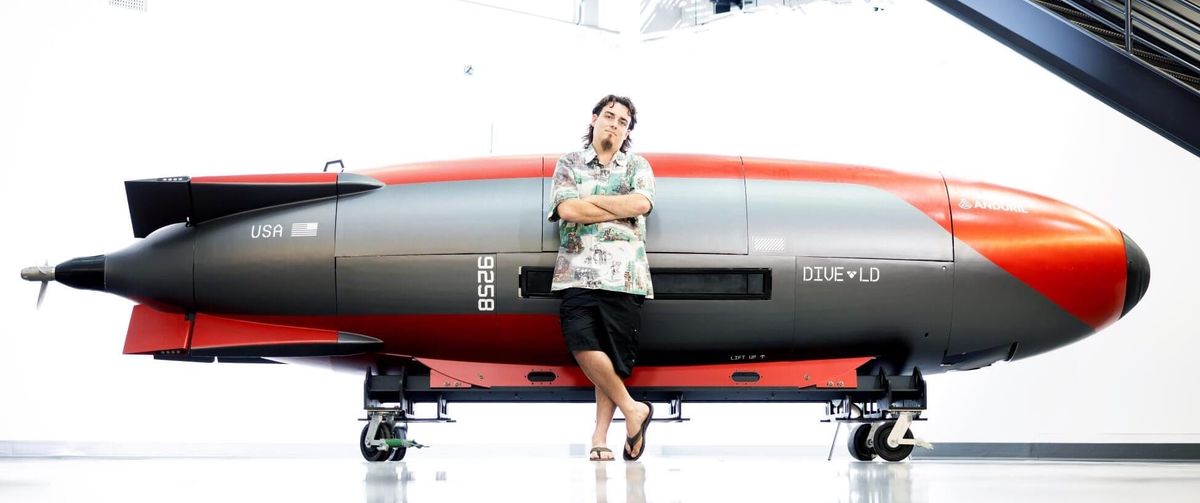
Luckey is easy to spot: mullet, goatee, cargo shorts, flip-flops and a bright Hawaiian shirt — one of them a Dungeons & Dragons print. The look is not an accident. To a Pentagon of dress uniforms and lobbyists in tailored suits, the incongruity is itself the message: a different kind of company has arrived, and it does not need your permission to exist.
But the costume shouldn't distract from the substance. This is a person who actually invents the hardware, and who has now done it across three unrelated industries. He collects retired military aircraft, stores a world-class game collection in a decommissioned Nike missile base, and — by marriage — is brother-in-law to former congressman Matt Gaetz.
One software platform, mass-produced hardware
Founded 2017 with Palantir veterans. Sells finished products, not decade-long development programmes.
Anduril was founded in 2017 by Luckey with Palantir alumni Brian Schimpf (CEO), Trae Stephens, Matt Grimm and Joe Chen. Its model inverts the traditional one. Instead of one bespoke, hyper-expensive system per customer over a decade-long cycle, Anduril builds mass-producible autonomous hardware around a single software platform — Lattice — that ships updates like commercial software and can command engaged systems rather than merely display data.
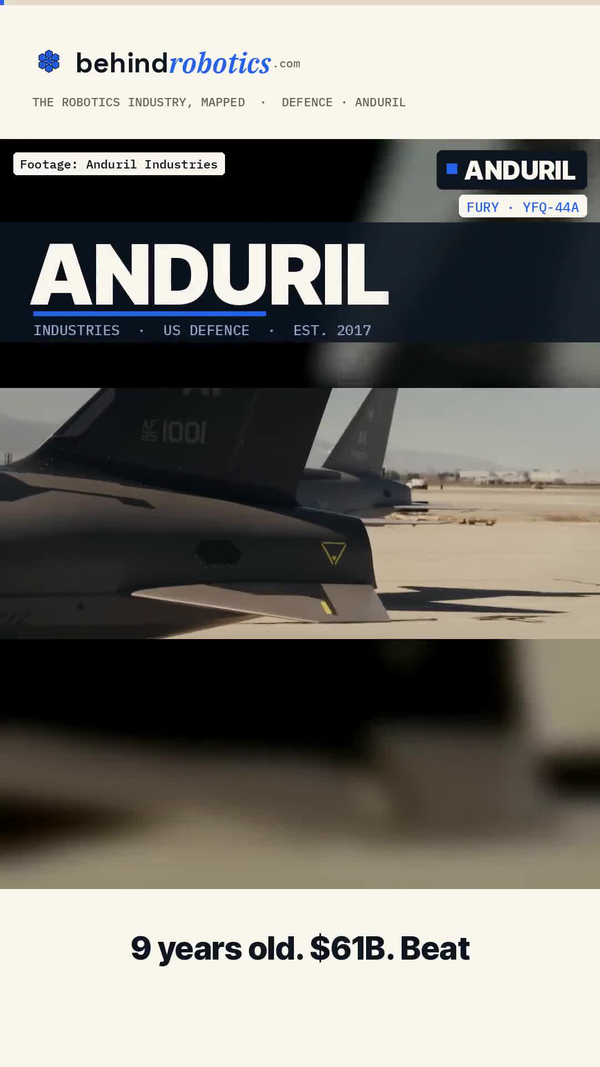
Anduril also funds much of its own R&D and sells finished products rather than living on cost-plus development contracts. When its Fury prototype beat Lockheed, Boeing and Raytheon for the Air Force's Collaborative Combat Aircraft programme, it was treated as a watershed — evidence the incumbents had missed a structural shift rather than simply lost a bid.

Two lines that opened the door
Since 2020 the US defence budget climbed toward $1 trillion — while venture money into defence tech grew roughly ninefold.
Anduril's timing is central to its story. Neither line alone would have been enough. The budget rising made room for new suppliers; the venture money arriving made it possible to build at risk, ahead of a contract, and show up with a finished product. Plotted together, they explain how a nine-year-old company could take work from contractors that had held the market for forty years.
US defence budget vs. defence-tech venture funding
Three shifts that made it possible
The budget went vertical. National-defence outlays rose from about $714B in 2020 to a $1 trillion topline in FY2026, up roughly 13% on FY2025, with proposals pushing toward $1.5T in total defence resources for FY2027.
Procurement got faster. The Pentagon leaned on Other Transaction Authority and Commercial Solutions Openings — contracting tools built for commercial technology. In July 2025 the Army handed Anduril a $99.6M OTA to build a command-and-control prototype in eleven months, and signalled it would not seize the intellectual property.
The taboo broke. Defence was once a venture no-go. Then Palantir passed $300B, SpaceX rewrote launch economics, and Anduril beat Lockheed head-to-head. Ten new defence-tech unicorns emerged in 2025, lifting the sector's combined value to roughly $495B.
Analysts now call this cohort — Anduril, Palantir, SpaceX, Shield AI, Saronic — "neoprimes": venture-built challengers to the five legacy giants. Their combined share of the budget is still a fraction of the primes'. The trajectory is what matters, and Anduril is furthest along it.
Eighteen systems, four domains, one operating system
From a single solar-powered surveillance tower in 2017 to a full-spectrum autonomous force. Tap any image with a play marker to watch the system in action.

The factory is the weapon
Every system on this page is downstream of one decision: that the constraint in modern defence is not design but output. A weapon that takes eleven years to field and costs a fortune per unit loses to a weapon that is merely adequate and arrives by the thousand.
So Anduril spent nearly $1 billion of its own money on Arsenal-1, a five-million-square-foot campus south of Columbus, Ohio, designed from a blank slate rather than squeezed into an existing plant. Fury production began there in March 2026, with Barracuda airframes, Menace and the Titan ground station to follow. A software layer — Arsenal OS — links design, development and mass production as one system, so a change made upstream propagates to the line.
It is the clearest statement of the thesis. The primes sell exquisite systems. Anduril is trying to sell volume, and volume is a manufacturing problem long before it is an engineering one.
invested
footprint
the decade
The bank called Erebor
Luckey co-founded a US national bank for crypto, AI and defence firms. Conditional OCC approval October 2025; full charter February 2026.
Luckey's range as a builder shows most clearly in what he does outside Anduril. After Silicon Valley Bank collapsed in 2023 — removing the main banking channel for a generation of startups — he and Palantir co-founder Joe Lonsdale set out to build a replacement. The result is Erebor, a fully digital national bank.
Erebor Bank, N.A.
What it does. Erebor is a full-service, FDIC-insured national bank built for a specific clientele: technology companies in crypto, AI, defence and manufacturing, plus the funds and people who back them. Its distinguishing feature is that it is stablecoin-native — it takes deposits and can settle in stablecoins, and offers crypto-collateralised lending, services conventional banks largely refuse. Among the 2025–26 wave of crypto charters, Erebor is notable for being a full insured bank rather than a trust licence. It runs under co-CEOs Jacob Hirshman (ex-Circle) and Owen Rapaport.
Why "conditional." The OCC granted preliminary conditional approval in October 2025 — unusually fast, roughly four months after filing — meaning the charter was approved subject to capital, compliance and security conditions before opening. FDIC insurance followed in December 2025 and the full charter in February 2026. The speed drew scrutiny: Senator Elizabeth Warren wrote to regulators questioning the process, and critics raised crypto-risk and political-proximity concerns, given that Luckey and Thiel are major Republican donors. Backers include Founders Fund and Haun Ventures.
erebor.bankNot space. Underground.
Asked which domain will define 21st-century defence, Luckey gives an answer almost nobody agrees with.
Asked whether space would be the decisive domain of this century, Luckey said no — it will be the subterranean domain. "But nobody agrees with me, and every time I talk about it, I sound insane to people," he said. "There's a lot more crust than there is air or sea or surface of land."
He tends to dangle a detail and then decline to elaborate. On one showroom tour a reporter noted a dozen products not yet public, plus one item — by far the largest in the room — that was strictly off the record. Asked about a teased subterranean vehicle, Luckey trailed off. Two grounded readings:
On space, Anduril is active but quieter; counter-space and orbital awareness fit the same sensor-fusion model. The underground bet is the one that makes him sound insane, which is exactly why it is worth watching. His last insane-sounding bet — that a startup could beat the primes — is now worth $61 billion.
Contracts, funding and revenue
A $61B valuation, a ten-year Army agreement, and production wins across every domain.
across nine rounds
a16z + Thrive
agreement ceiling
Ghost Shark programme
Anduril does not disclose profitability, and an IPO — repeatedly floated — has not been filed. Different products fight different incumbents: Roadrunner and Anvil against RTX and Boeing in counter-UAS; Pulsar against L3Harris in electronic warfare; Lattice against Palantir itself. Valuation figures vary by source and round: $8.5B in 2023, $30.5B after a 2025 round, $61B in 2026.
Strip away the Hawaiian shirts and Anduril is a serious bet: that a software platform plus mass-produced, AI-first hardware beats the one-expensive-system-per-customer model — and that a hardware inventor can build across weapons, banking and consumer technology at the same time. Luckey has now proved the thesis three times: Oculus, Anduril, and a chartered national bank. That makes him less a defence curiosity than one of this era's most productive inventor-founders.
Sources & further reading
Figures are drawn from public sources on the dates shown; some — valuations, budget toplines, programme values — vary by source and definition. The budget-versus-VC chart compares trajectories on independent scales, not a shared axis. Product imagery and video are the property of Anduril Industries and are used editorially. Analysis, not investment advice.
The unfair fight: how Palmer Luckey built a $61B defence company in nine years
Homeschooled hardware hacker. Built the Oculus Rift in a trailer, sold it to Facebook for ~$2B at 21, was pushed out in 2017 over a political donation, and founded Anduril the same year with four Palantir alumni.
Mass-producible autonomous hardware built around one software platform — Lattice — funded largely by its own R&D rather than cost-plus contracts. Anduril sells finished products, and ships updates like commercial software.
Eighteen-plus systems across air, sea, land and spectrum: Fury (CCA, in production), Thunder (Group 5 attack rotorcraft), Omen, Ghost, Bolt, Altius, Barracuda, Roadrunner, Anvil, Dive-XL / Ghost Shark, Sentry, Pulsar, Wisp, Spyglass, EagleEye, Menace and Menace-X.
The US defence budget rose from ~$714B in 2020 to a $1T topline in FY2026, while defence-tech venture funding grew roughly ninefold. Faster contracting tools (OTA, CSO) did the rest. The cohort is now called the "neoprimes."
$61B valuation, ~$2B 2025 revenue, $6.9B+ raised. A ten-year US Army agreement with a $20B ceiling; $1.1B from Australia for Ghost Shark; up to $22B for the soldier-headset programme inherited from Microsoft.
Erebor — a stablecoin-native, FDIC-insured national bank for crypto, AI and defence firms, co-founded with Joe Lonsdale. Conditional OCC approval October 2025, full charter February 2026, ~$635M opening capital. Named, like Palantir and Anduril, after Tolkien.
Not space — underground. Luckey argues the subterranean domain will be decisive, and says openly that almost nobody agrees with him.