Old muscle, new giant: Beijing bets on the hydraulics Boston Dynamics dropped
NeodraDynamics' Neo1 is four metres tall and claims a 500 kg two-arm payload, about 3.4 times the strongest humanoid in our database. It runs on the technology Boston Dynamics retired in 2024. It has no deployed units yet, and its JD Industrial pilot has no site, contract or date.
NeodraDynamics' Neo1 is four metres tall and claims a 500 kg two-arm payload, about 3.4 times the strongest humanoid in our database. It runs on the technology Boston Dynamics retired in 2024. It has no deployed units yet, and its JD Industrial pilot has no site, contract or date.
In April 2024 Boston Dynamics posted a three-minute video called "Farewell to HD Atlas". The hydraulic humanoid that had backflipped through a decade of viral clips was retired. A day later the company unveiled its replacement, and it was fully electric.
Six months later, on October 8, 2024, a company called 清卓动力 was registered in Beijing's Chaoyang district. Its bet was hydraulics.
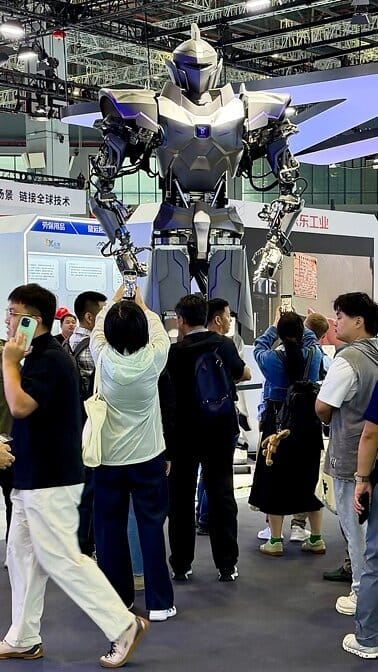
Two years on, that company, NeodraDynamics, has put a four-metre humanoid called Neo1 on two of China's biggest show floors. Its headline number: a 500 kg payload.
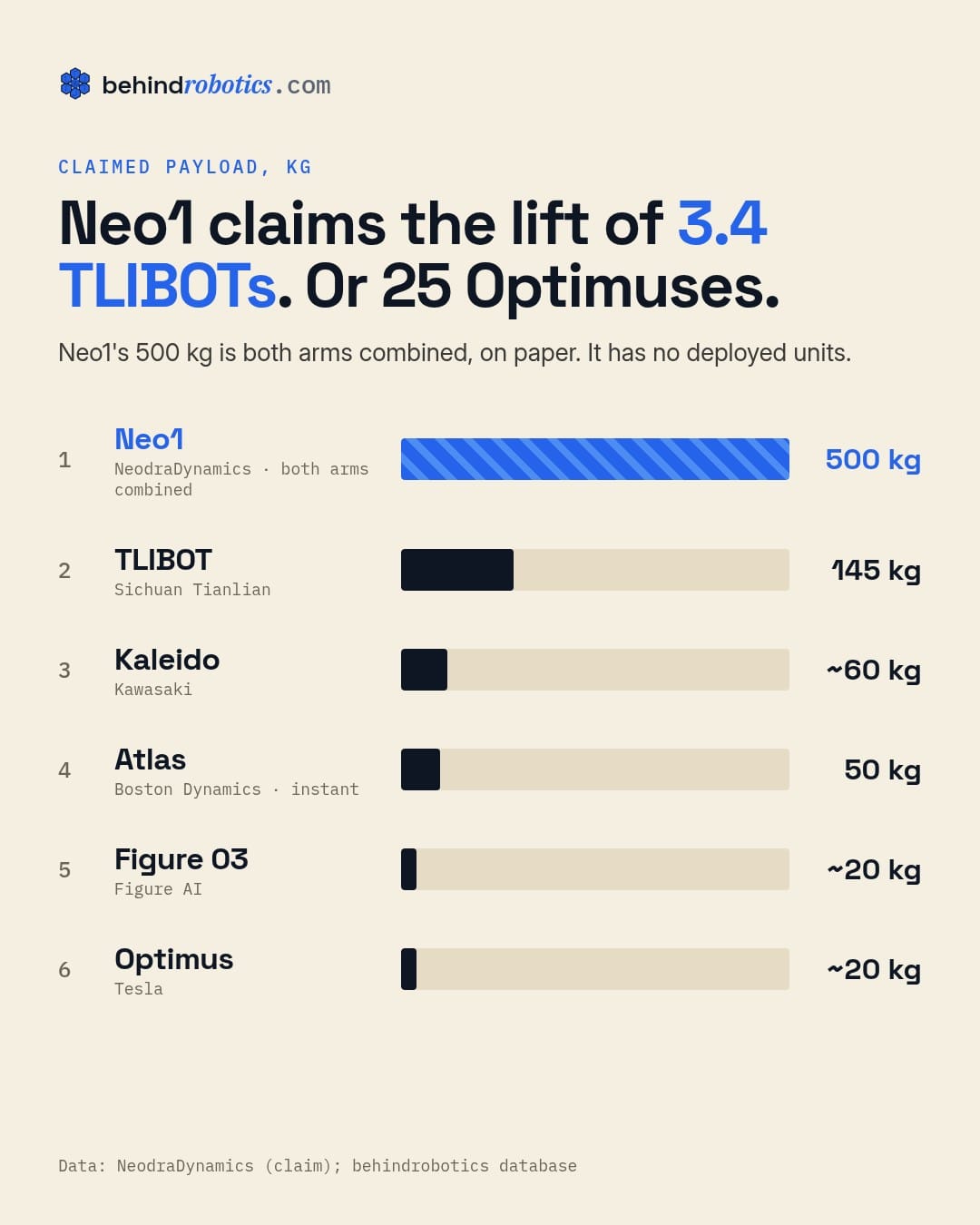
Read that number carefully. The 500 kg is both arms working together ("500kg dual-arm collaborative payload", in the company's words), not one arm. Even so, it is about 3.4 times TLIBOT, the strongest of the 145 humanoids in the behindrobotics database at 145 kg. It is about 25 times Figure 03 or Tesla's Optimus, at roughly 20 kg each.
Then there is the other number: zero. Neo1 has no deployed units. Its link with JD Industrial is a joint pilot, with no named site, contract or statement from JD. And every spec in this piece is the company's own claim. None has been independently tested.
Who built it
The company is 清卓动力机器人科技(北京)有限公司, NeodraDynamics Robotics Technology (Beijing) in English. It sits in Wangjing SOHO and was registered on 2024-10-08, according to its website and registry data.
It lists three co-founders with Tsinghua backgrounds:
- Yang Tao 杨涛: founder and legal representative, billed as the "inventor of digital hydraulics".
- Jianwei Zhang 张建伟: a foreign member of the Chinese Academy of Engineering and a member of acatech.
- Jian Wang 王健: sits on the MIIT robot standards committee.
Yang's hydraulics run in the family. In an October interview with Tencent News, he said his father began researching digital hydraulics in the late 1970s. In 1998 the two of them founded Yimeibo (亿美博), which builds hydraulic controls for steel mills. The company pitches its digital hydraulics as a "generational upgrade" over the servo-valve hydraulics that powered machines like the old Atlas.
The company is still small. Registry data shows registered capital of RMB 1.17 million. Its 2025 annual report lists zero staff on social insurance. Aggregators describe an angel round, but no amount has been disclosed and we could not confirm the investors. None of this is unusual for a two-year-old startup. It is useful context for claims this big.
The machine, by the company's numbers
Neo1 stands about 4 metres tall. The October press release headline puts it at 1.2 tonnes, and that is the only place the figure appears.
It has 41 active joints:
- 14 in the arms
- 10 in the hands
- 12 in the legs and feet
- 3 in the waist
- 2 in the head
39 of them run on NeodraDynamics' own miniature digital hydraulic linear actuators. Only the two forearm-rotation joints are electric. Each hand has 15 joints. Five of them are driven hydraulically and the other ten are coupled.
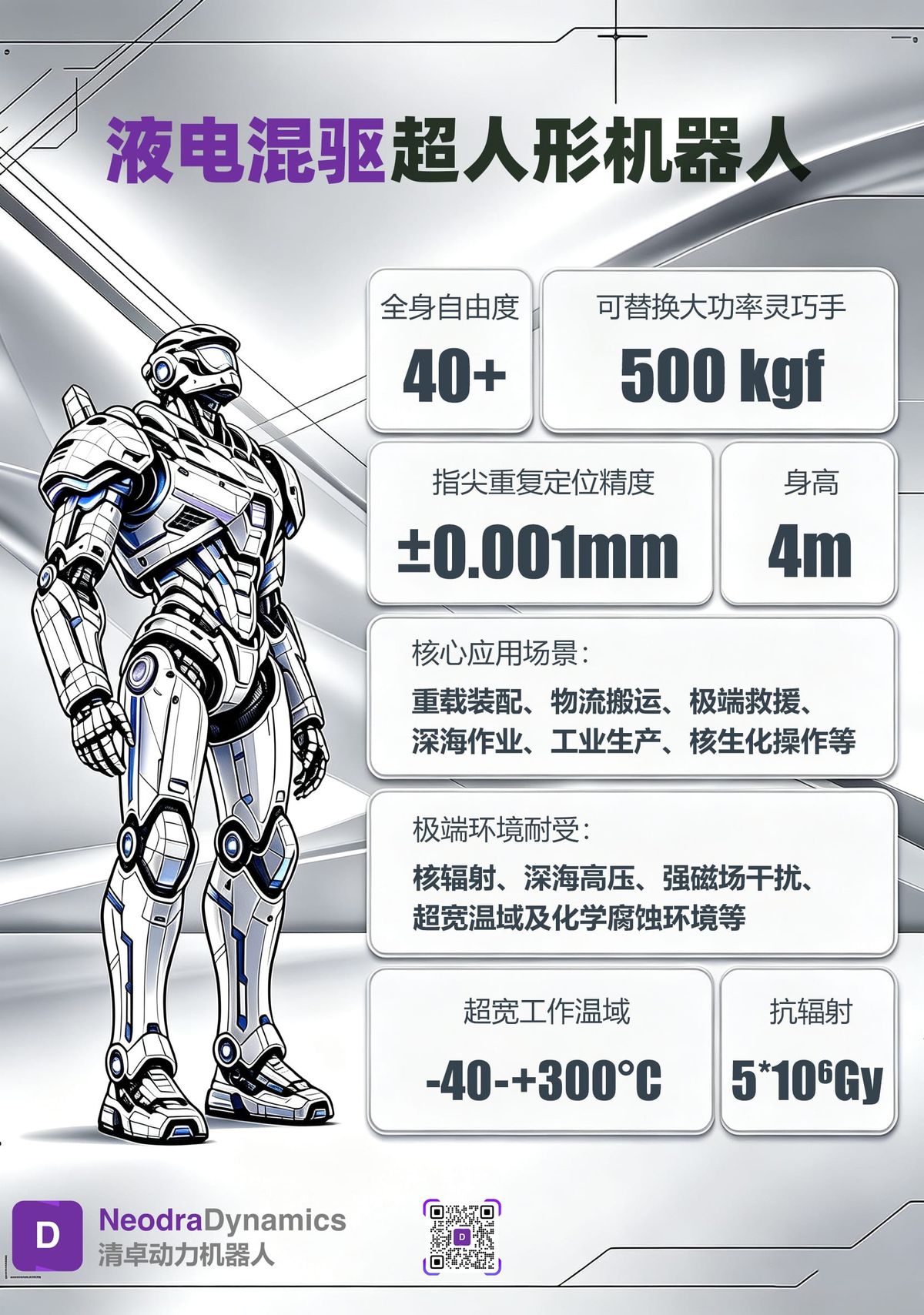
Each actuator weighs about 1 kg and delivers "ton-level continuous thrust", according to the October release. The September release puts it at 1.1 kg, driving a 1,000 kg load. The company website lists 1.6 kg, 10 kN and 50 mm/s. The website also gives 300 kg per arm and a 500 kgf hand grip, separately from the 500 kg two-arm figure.
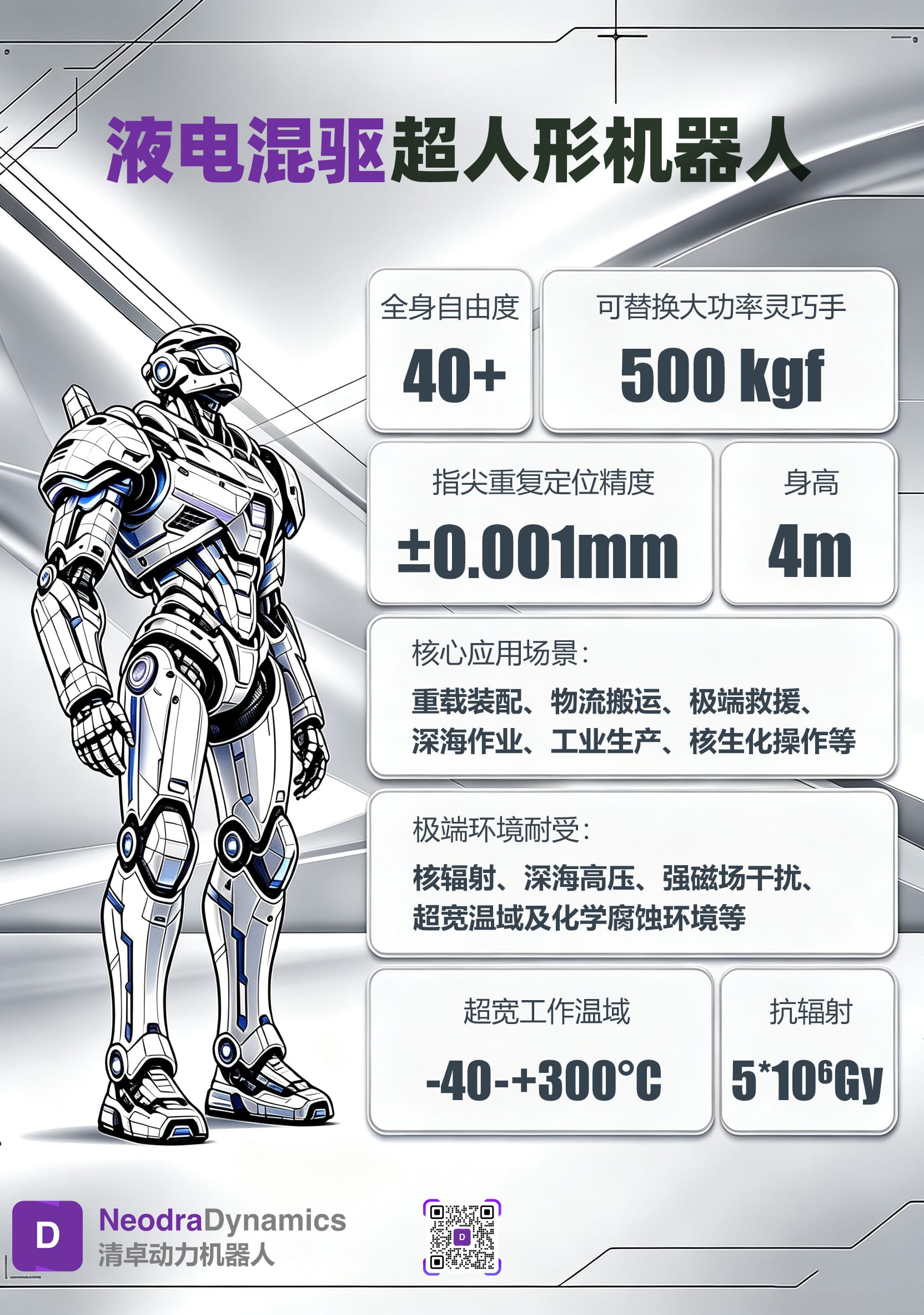
The precision claims are where the numbers really drift. NeodraDynamics has published four different figures:
- ±0.05 mm fingertip repeatability in the September press release
- ±0.005 mm repeat positioning in the October press release
- "Better than 0.1 mm" in the Tencent interview on October 12
- ±0.001 mm on the World Robot Conference exhibit poster
None of them comes with a load, a reach or test conditions. Precision under no load and precision while holding half a tonne are different claims.
Did Boston Dynamics really give up?
The hydraulic Atlas began in 2013, built for the DARPA disaster-response competition. It became the most famous humanoid in the world by running, jumping and flipping. On April 16, 2024 Boston Dynamics retired it, and the next day it announced an electric Atlas that would be "stronger, with a broader range of motion". Testing started with Hyundai.
NeodraDynamics has built its marketing on that moment. Its September release ran under the headline "Boston Dynamics Gave Up on Hydraulics." It argued that "what the industry retired was an old control paradigm, not hydraulics themselves". Yang himself is more careful. He told Tencent that Boston Dynamics was "waiting for a hydraulics breakthrough, not giving up". Tech blogger Mike Kalil reports that Yang argued at the conference that the electric Atlas is clumsier than the hydraulic one.
Our read: both things can be true. Electric won at human scale, where a robot is meant to be light, quiet and safe around people. Humanoid.guide notes that Boston Dynamics' decision concerned a much smaller machine. At four metres and 1.2 tonnes, Neo1 plays a different game, closer to a hydraulic excavator than to Optimus.
Is it a humanoid at all?
The company calls Neo1 a "super humanoid". It says it doesn't aim to copy the human body or insist on walking on two legs. Form, size and end tools get reconfigured for each job, it told Huanqiu.
Neo1 has 12 leg and foot joints, but no source we found shows it walking unsupported. Mike Kalil describes it as a stationary machine, as cited by Humanoid.guide. That is his description, not the company's.
The gaps are bigger than the specs:
- Nobody has said what powers it: an onboard pump or a tether.
- No runtime, sensor or compute data has been published.
- The website says Neo1 works "with machine vision, VLA models and WMA". It gives no detail on how much of that is autonomy and how much is teleoperation.
- There is no word on the classic hydraulic chores: leaks, seals, heat and maintenance.
Yang also says the full robot isn't really the product. NeodraDynamics sees itself as an enabler that sells high-force hands, arms and actuators to partners. It builds whole robots only for places where no robots work yet: nuclear sites, the deep sea, aerospace and rescue.
The JD Industrial question
Neo1 first appeared at the World Robot Conference in Beijing's Yizhuang district, which ran from August 19 to 23. In October it came back at the China International Industry Fair (CIIF) in Shanghai, which ran from October 12 to 16. This time it stood on the JD Industrial booth, towering over the crowd.
The October release says the two companies will "jointly verify industrial landing solutions" through "scenario matching and pilot application". JD Industrial brings its "industrial supply chain and end-user scenario resources". That is the whole deal as published. There is no site, customer, contract value, start date, price or delivery date, and we found no statement from JD Industrial itself.
The partner matters, though. JD Industrials has been listed in Hong Kong as 7618.HK since December 11, 2025. In July 2025 its parent JD.com led funding rounds in Spirit AI, LimX Dynamics and EngineAI. Our read: Neo1 gives JD a heavy-industry showpiece to go with those capital bets. A showpiece is not yet a deployment.
Weaker, but working
The best comparison isn't Optimus. It is the giant machines that already earn money.
Since July 2024, JR West in Japan has used a teleoperated humanoid upper body on a 12-metre boom, built with Jinki Ittai and Nippon Signal. It paints rail supports and cuts trees. Its grip is just 40 kg, about a twelfth of Neo1's claim. JR West says it needs about 30% fewer workers for the job.
Japan's Tsubame Industries showed the piloted ARCHAX in 2023: 4.5 metres, 3.5 tonnes and about $3 million each, with a first lot of five units. It is weaker on paper and more modest in its promises, but it has a published price.
That's the bar for Neo1. Giant robots have a real market, as long as they turn up on site and do the job.
What would change our mind
- A payload figure with its reach and posture, and one precision number with its load.
- Power and runtime data, and an answer to the tether question.
- A named JD Industrial site, a start date and a JD statement.
- Video of Neo1 doing one real industrial task from start to finish.
Boston Dynamics dropped hydraulics so it could deliver. NeodraDynamics now has to deliver with them. The 500 kg claim is the hook. The real test is the first named site and the first unit deployed.
Database: NeodraDynamics · Neo1
All Neo1 specifications are NeodraDynamics' own claims and have not been independently tested. Every number links to its source. Paragraphs marked "our read" are analysis. behindrobotics received no payment or products from any company named.