Usain Bolts world record gets crushed - by a humanoid - here is the data
Humanoid · Event · Beijing
Faster than Bolt, higher than the world record: inside the 2026 World Humanoid Robot Games
Over five days in Beijing, more than 2,000 humanoid robots ran, jumped, boxed and played football. Two of them beat marks that took humans a century to set. Here's what actually happened — and what the spectacle conveniently leaves out.
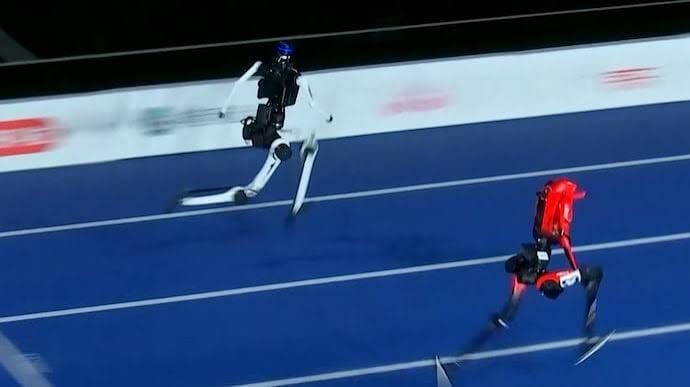
On Saturday evening at Beijing's "Ice Ribbon" — the National Speed Skating Oval built for the 2022 Winter Olympics — a humanoid robot crossed a 100-metre finish line in 9.39 seconds. Usain Bolt's human world record, set in 2009 and untouched since, is 9.58. In a separate event, another machine cleared 2.88 metres in a standing high jump, sailing over the 2.45m human record that has stood since 1993.
The headlines wrote themselves: robots are now faster and higher-jumping than the best humans who have ever lived. Both are true. Both also need an asterisk — and the asterisk is the real story.
01 The two records that broke
Both record-setting robots came from X-Humanoid, the Beijing state-backed innovation center behind the Tiangong (天工, "Tien Kung") series. There's a second contender in the sprint conversation too: before the opening ceremony, a robot called Lightning, built by smartphone maker Honor, reportedly clocked 9.32 seconds in a test run at a peak speed of 14.5 metres per second — even faster, though set outside the formal heats.
To feel the pace of progress: at the first edition of these Games in 2025, the winning 100m time was 21.5 seconds and the best humanoid high jump was 0.95m. One year later, the sprint has been more than halved and the jump has nearly tripled. That curve — not the Bolt comparison — is what should make the industry sit up.
02 The fastest robot, on video
Deutsche Welle sent reporters to investigate the sprint spectacle up close — how the times are set, what the machines actually do, and how much is autonomy versus stagecraft. It's the best single explainer on the record run:
DW investigative reportage — the humanoid sprint records, examined
The uncomfortable detail the footage makes clear: these are not humanoids jogging out, lining up, and racing autonomously end-to-end the way a human sprinter does. Runs are heavily engineered, often closely shadowed by human operators, and tuned for a single explosive discipline. The 9.39 is real — but it is a lab-grade result staged for a track, not evidence that a robot could win an Olympic heat under athletics rules.
03 The highest jump
The 2.88m standing high jump is arguably the more impressive feat than the sprint — it demands explosive power-to-weight, mid-air stabilisation, and a controlled landing that doesn't shatter an expensive machine. Clearing nearly three metres from a standstill is well beyond any human, and unlike the sprint it's harder to "operator-assist" your way through. It's a genuine demonstration of how far actuator torque density and balance control have come in twelve months.
Unitree humanoid — high jump demonstration
Explosive jumping and high-speed running stress exactly the systems that matter for real deployment: actuators, power delivery, thermal limits, and whole-body balance. Athletics is a proxy benchmark. A robot that can sprint and land a 2.88m jump is demonstrating hardware that could, eventually, do useful dynamic work — even if today it mostly does demonstrations.
04 What the Games actually were
The 2nd World Humanoid Robot Games ran 15–17 August through the following week in Beijing, overlapping with the 2026 World Robot Conference across town (where some 3,000 products were shown). The scale, by the organiser's numbers:
Disciplines spanned three broad groups
Track & field
100m, 400m, 1500m, 4×100m relay, hurdles, high jump — the events that produced the headline records.
Sport & combat
5-a-side football (a marquee event), boxing and kickboxing, table tennis, and basketball. The football and combat events are where autonomy is tested hardest — and where robots most often stumbled, literally.
Practical tasks
Medicine sorting, cleaning, industrial handling and material sorting — the "real work" categories meant to point past spectacle toward deployment.
05 The companies and robots
This is where the Games double as an industry map. Below are the notable competitors, their machines, and — flagged directly — which we already track in the behindrobotics.com database.
| Company | Robot | Notable result | In our DB? |
|---|---|---|---|
| X-Humanoid | Tiangong Ultra | 100m 9.39s · high jump 2.88m — both beat human WRs | Just added |
| Honor | Lightning | 100m 9.47s (heat) · 9.32s test · 14.5 m/s peak | Just added |
| Unitree | H1 / H2 | Multiple running medals; dominant 2025 track team | Tracked |
| Booster Robotics | Booster T1 | Football platform; RoboCup humanoid pedigree | Just added |
| UBTECH | Walker series | Industrial/athletics entrant | Tracked |
| AgiBot | A2 | Competition entrant | Tracked |
| Fourier Intelligence | GR series | Competition entrant | Tracked |
| EngineAI | — | Competition entrant | Tracked |
| RobotEra | — | Competition entrant | Tracked |
| Noetix Robotics | — | Competition entrant | Tracked |
06 The part the headlines skip
Independent observers on the ground described a messier picture than the record times suggest. Robots toppled and collapsed and needed humans to lift them, swap batteries, and reset them between attempts. In team events like football, machines got stuck in scrums and fell in clusters — when one went down, others followed, because they lack the individual recovery reflex a human has. Experts quoted across the coverage were blunt: humanoids remain, for now, mostly demonstration, performance and research platforms — not deployed workers.
None of that erases the achievement. It contextualises it. A 9.39 sprint and a 2.88 jump are real hardware milestones. They are also single-discipline, heavily-supported showcases — the robotics equivalent of a concept car doing a hot lap, not a production vehicle you can buy. The honest read for anyone tracking this industry: the capability curve is bending upward astonishingly fast, while autonomous real-world reliability is still the unsolved problem worth watching.
That geopolitical subtext matters too. The Games opened the same week the U.S. FCC moved to restrict imports of foreign-made humanoids on national-security grounds, and shortly after the Pentagon added Unitree to a list of firms it says have military ties. The spectacle in the Ice Ribbon wasn't only sport. It was a national-capability demonstration, staged deliberately, at Olympic scale.
Sources & further reading
Associated Press / ESPN — Humanoid robots surpass human records in 100m, high jump
NBC News — Move over, Usain Bolt: robots smash human records
Global Times — Humanoid robot breaks human 100m record with 9.39 dash
Video: DW investigation — youtu.be/MU4R0W0dQ28
behindrobotics.com · Our own read, always sourced. We add our editorial cut but never invent facts.