Same movie, new machines: robotics is the EV rout all over again
We walked CIIF 2026 in Shanghai. Chinese arms massaged, sorted and shipped while a well-funded German humanoid hung motionless from its frame. DiDi, the bike-share bubble and the EV rout show how this story tends to end, and where it might not.
We walked CIIF 2026 in Shanghai. Chinese arms massaged, sorted and shipped while a well-funded German humanoid hung motionless from its frame. DiDi, the bike-share bubble and the EV rout show how this story tends to end, and where it might not.
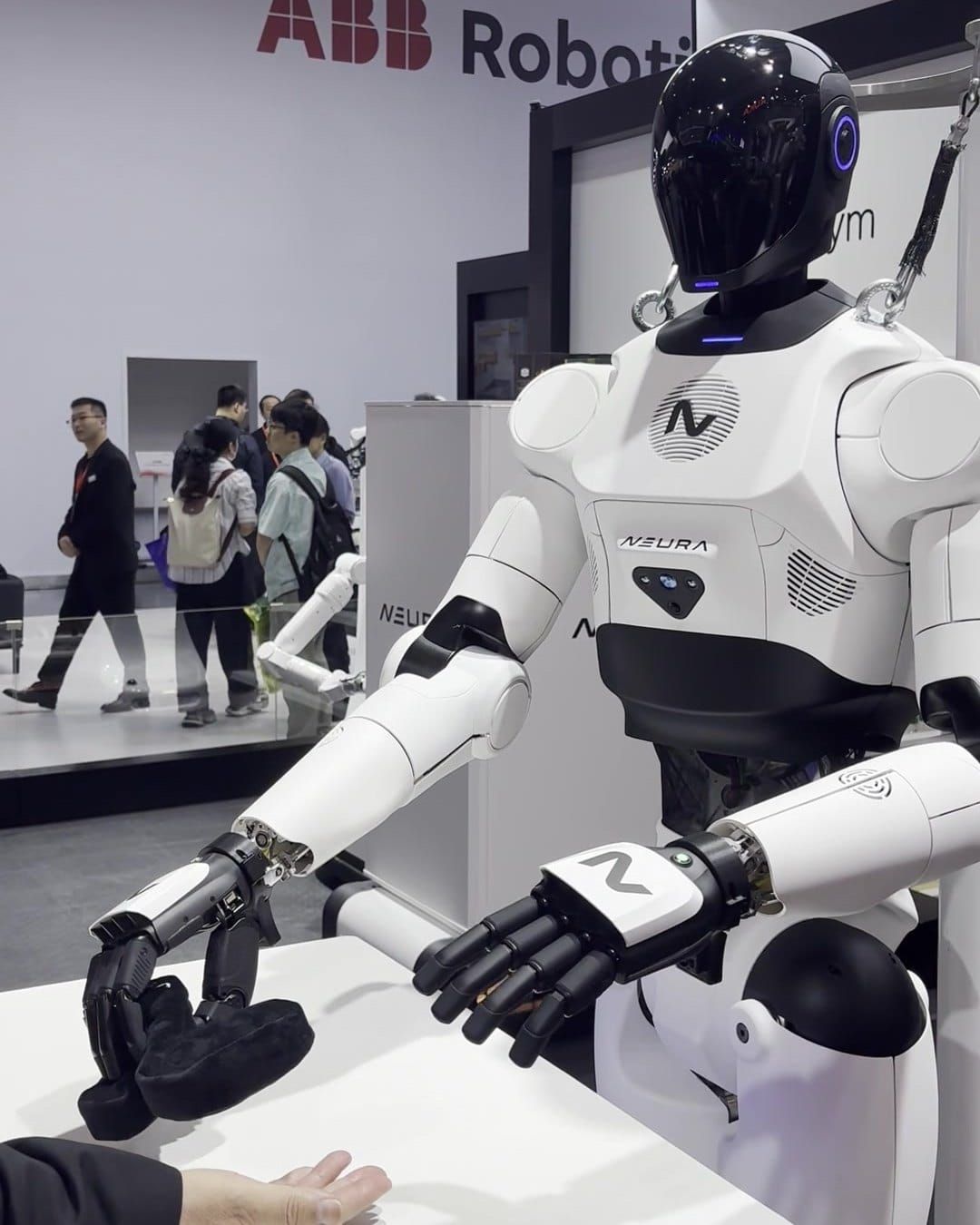
The massage robot had a queue.
On the robotics show floor at the National Exhibition and Convention Center in Shanghai, a white FAIRINO six-axis arm worked a padded head down a visitor's back. Its tool pressed and released while a small crowd filmed it on their phones. Nobody asked whether it could. They asked what it cost. FAIRINO launched its FR5 at a guidance price of ¥23,800. A US dealer lists the FR5 at $7,999 next to a UR5e at $38,363, about a fifth of the price on our math.
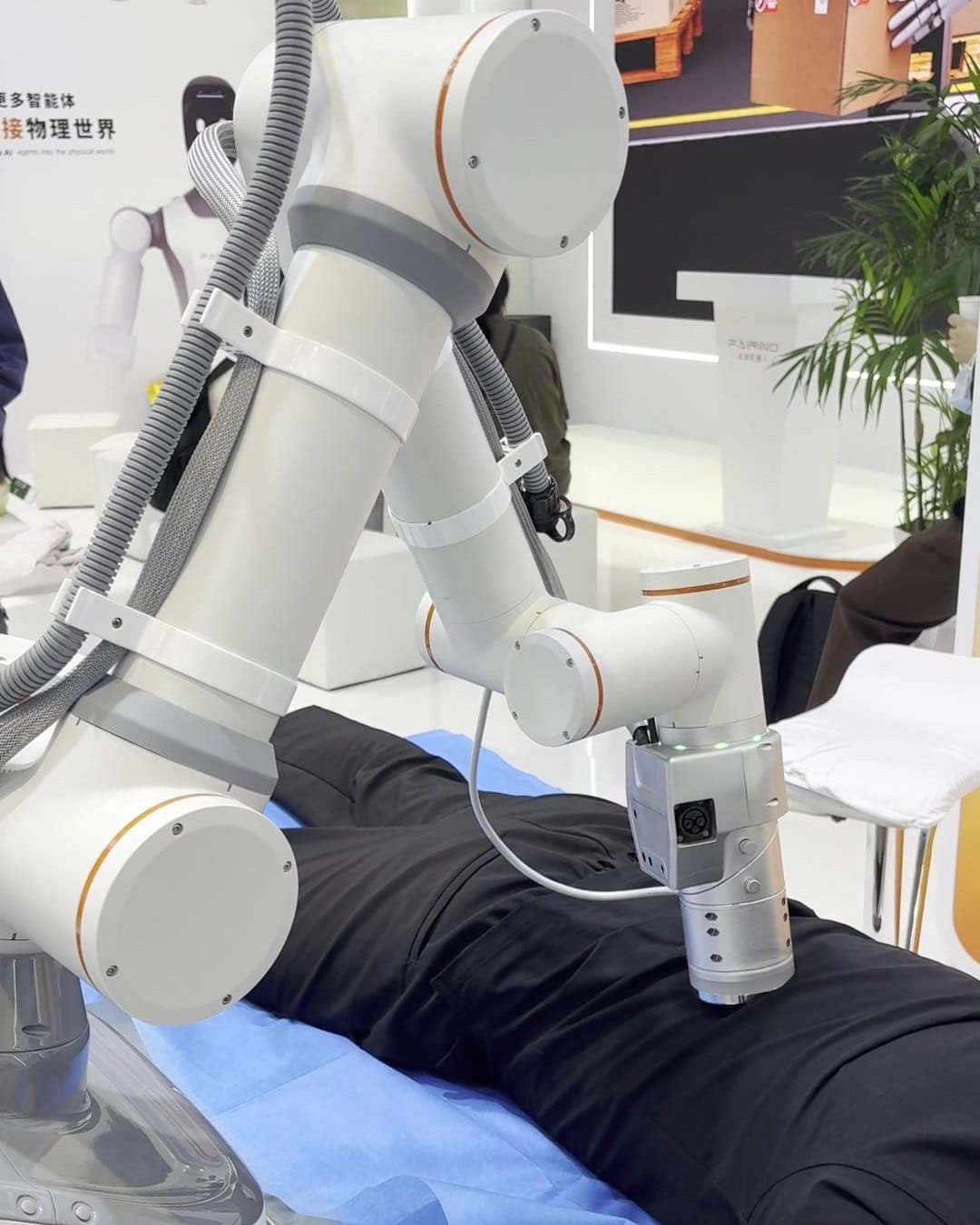
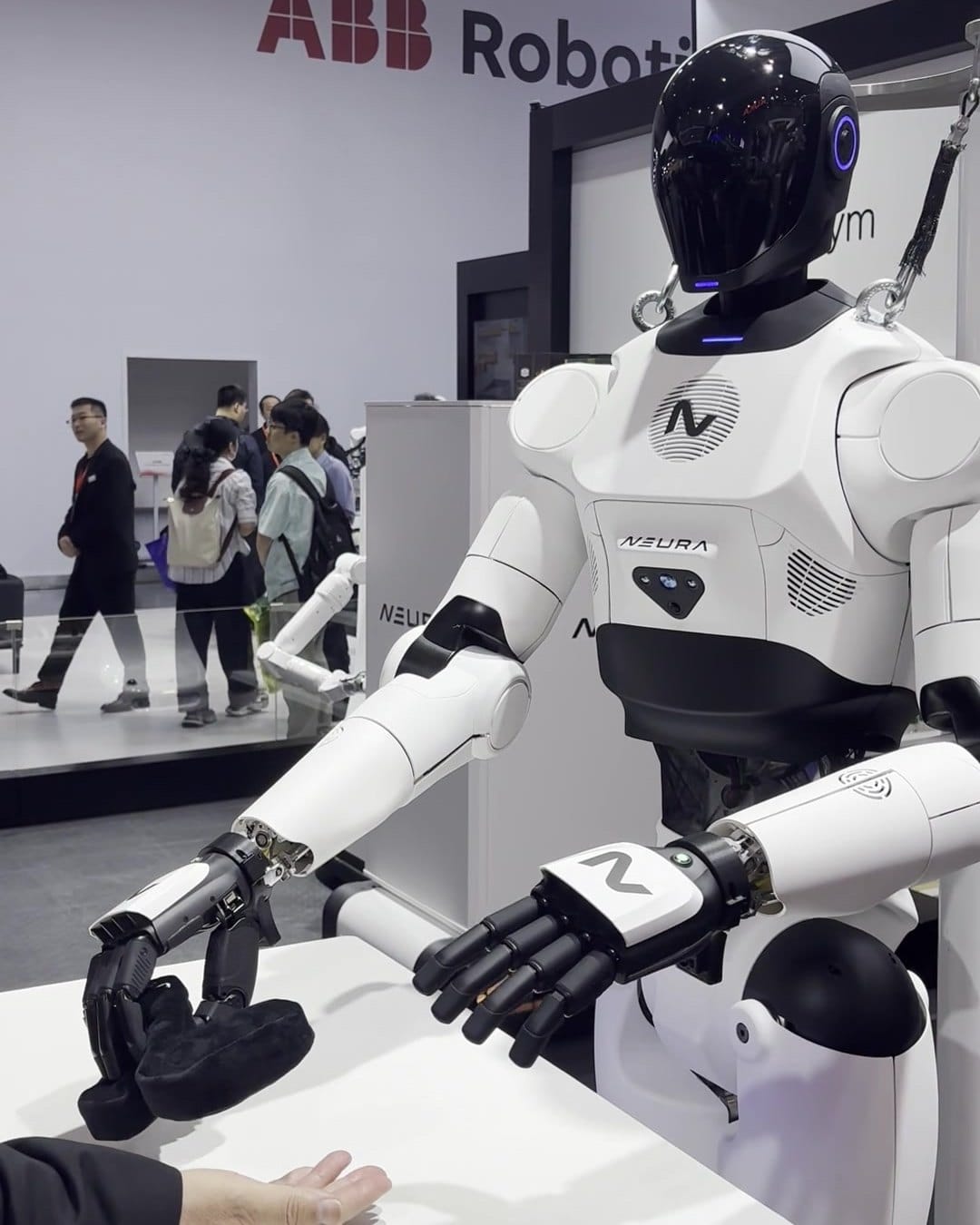
Then we walked into Hall 8.1, the international hall. ABB, FANUC, KUKA and Yaskawa had the big booths, polished as ever. A yellow FANUC SCARA ticked through its cycle behind glass. Near ABB's sign stood NEURA's 4NE-1 humanoid. The German company announced a Series C of up to $1.4 billion in June, with the full amount tied to milestones. During our visit the robot hung on its gantry with its hands resting on a table, and it did not move.
That's one booth on one afternoon, not a verdict on NEURA's engineering. But the two halls told a story we have seen before. One side sells finished machines at prices that reset the market. The other side sells the promise of a better one.
CIIF 2026 ran from October 12 to 16, with more than 3,000 exhibitors across the show and 349 in the robotics show alone. Hall 7.1 belonged to Chinese makers. Hall 8.1 held the foreign titans plus a humanoid zone that also held Chinese firms such as Unitree and Fourier. Our thesis is simple and uncomfortable. Robotics is heading for an EV-style déjà vu: China wins on scale, supply chain, price and delivery, and foreign incumbents find out too late that "better engineered" is not a business model. China has run this play at least three times. Each one teaches something different.
What we saw on the floor
The Chinese hall was not a gallery of prototypes. MOKA's white arms worked a parts cell, one of them running a laser-type head along a metal workpiece. (We could not confirm the exact process, so we won't call it welding.) UBTECH's wheeled robot, with "DREAM WITH ROBOTS" on its column, lifted cartons from a pallet without fuss. An orange wheeled humanoid under the Unitree banner moved totes. LEJU's humanoid boxed for a ring of onlookers.
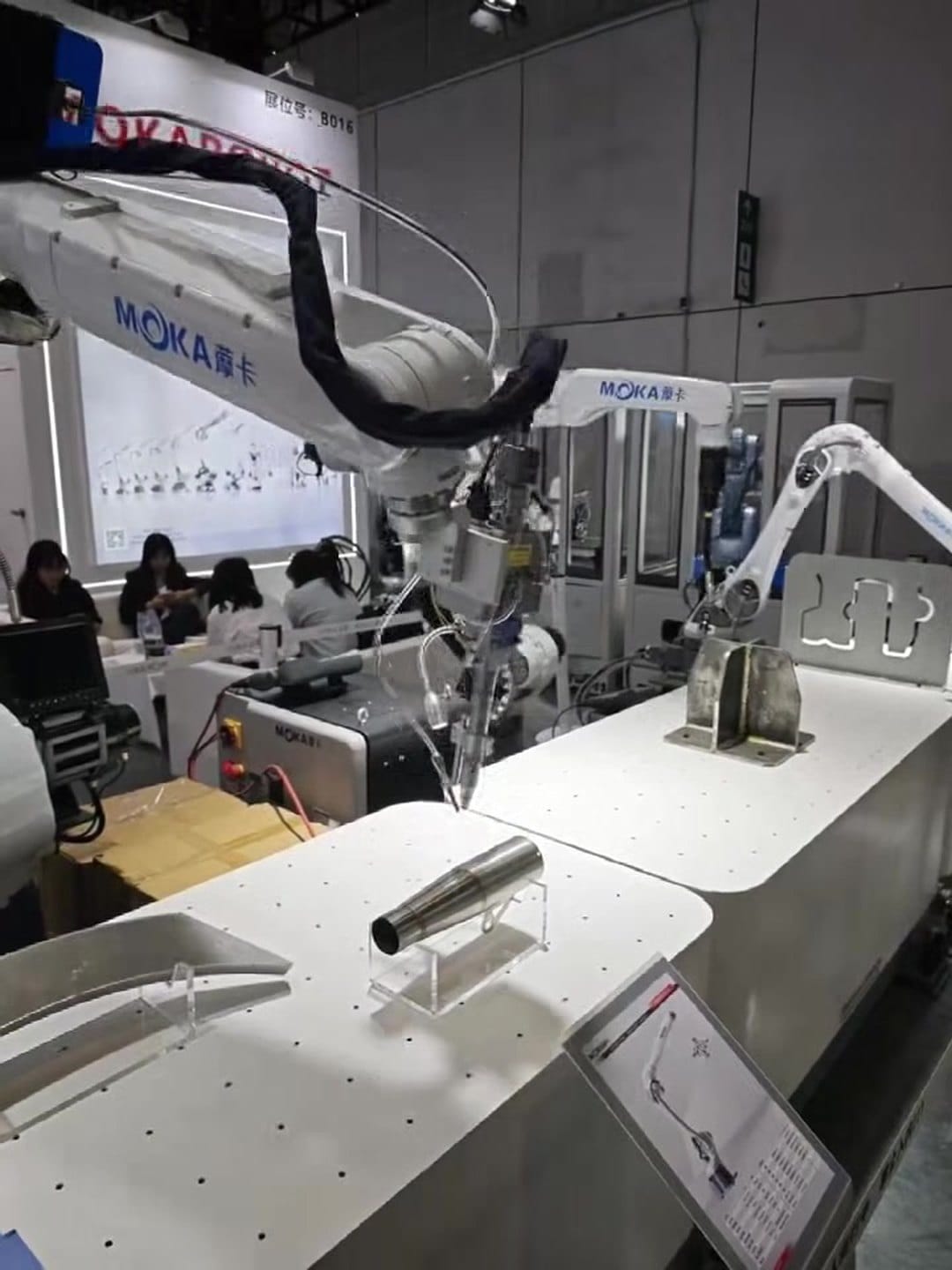
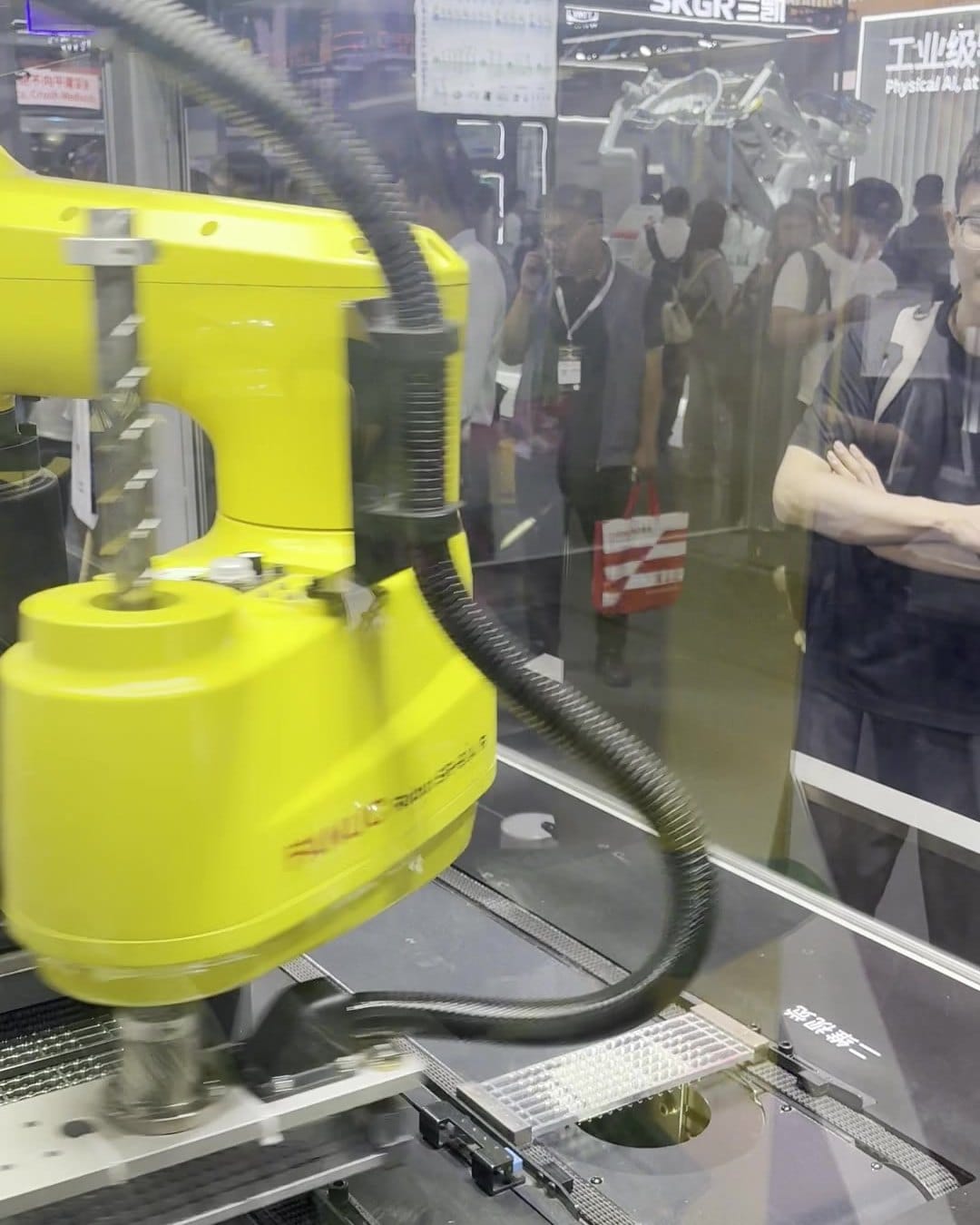
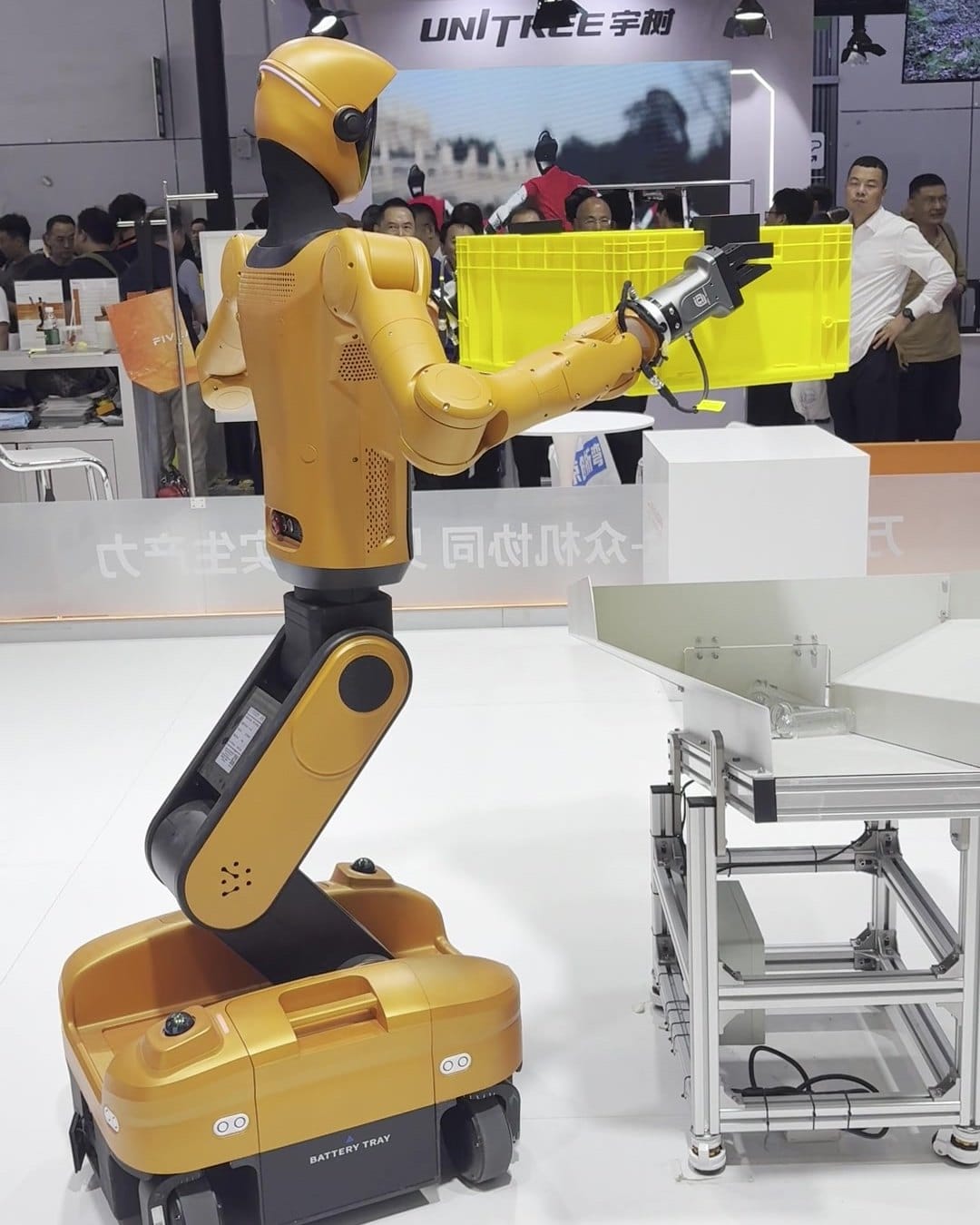
Left: a FANUC SCARA in the international hall. Right: a wheeled humanoid moving totes under the Unitree banner. Photos: behindrobotics at CIIF 2026.
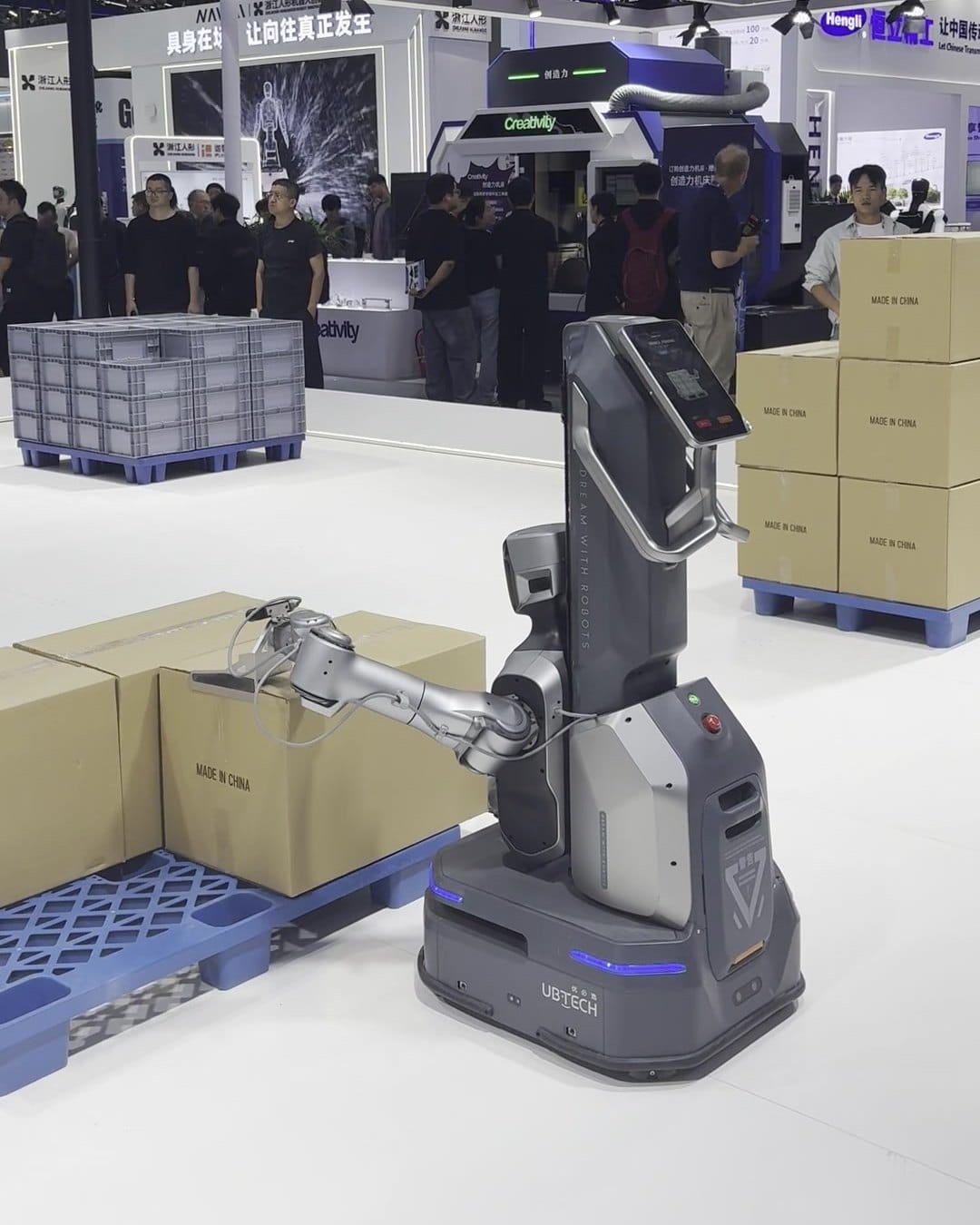
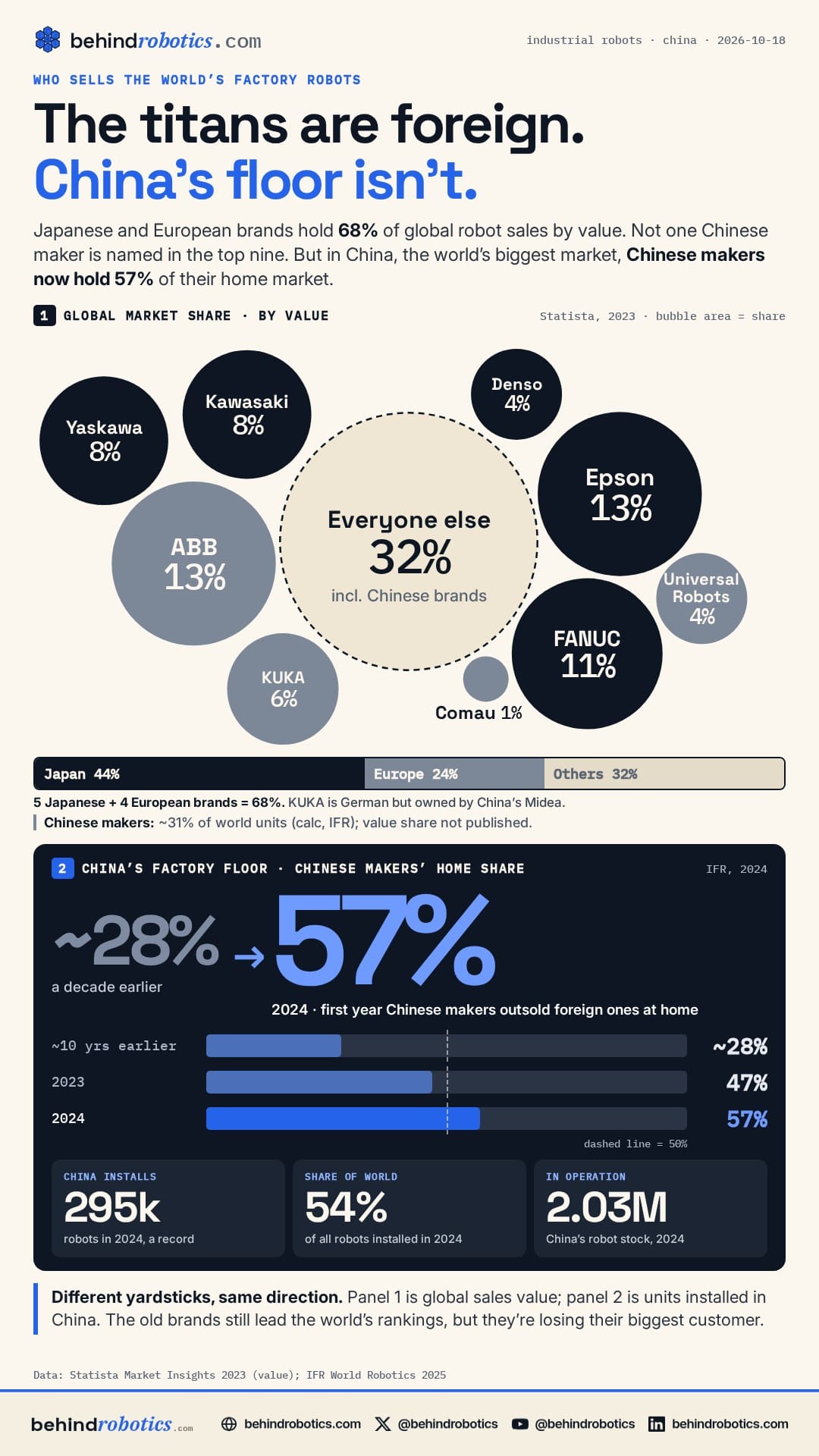
This is what the data says too. In 2024 Chinese suppliers took 57% of China's industrial-robot market. That was the first year they outsold foreign brands. A decade earlier they had about 28% (IFR). China installed 295,000 robots that year, 54% of the world total. Domestic output keeps climbing: the National Bureau of Statistics counted 773,000 industrial robots produced in 2025, up 28%, plus 18.58 million service robots.
Lesson one: DiDi and the subsidy war
In February 2016, Travis Kalanick said the quiet part out loud. "We're profitable in the USA, but we're losing over $1 billion a year in China." Didi had fired first in May 2015 with RMB 1 billion in free rides. Uber matched it, raised more money and promised to double its Chinese cities. People familiar with the matter later put Uber's total China bill at about $2 billion.
Then the rules changed. Days after Beijing banned pricing rides below cost, Uber gave up. On August 1, 2016 it sold Uber China to Didi for a 17.7% economic interest in the combined company. Didi was claiming more than 87% of China's private ride-hailing market at the time. A decade on, DiDi's core platform handled RMB 450.8 billion of gross transaction value in 2025 and 13.7 billion rides in China.
The lesson for robotics is not that China always wins. It's how the home market gets won: local operations, regulatory fluency, channel density and an investor base willing to fund losses until the rival quits. The foreign brand had the better global product and lost anyway.
The honest coda matters just as much. DiDi went abroad in 2018, buying Brazil's 99 at a ~$1 billion valuation and launching in Mexico, then Chile, Colombia, Peru and others. International GTV reached RMB 117 billion in 2025. But Uber booked $193 billion in 2025 gross bookings. DiDi's whole core platform is roughly a third of that on our conversion, and the definitions differ. DiDi also pulled its food business out of Brazil, the Dominican Republic and Chile. Winning at home is not the same as winning the world. Robotics should expect a similar split: China first, emerging markets second, and a long fight in Europe and the US.
Lesson two: bikes, the boom that ate itself
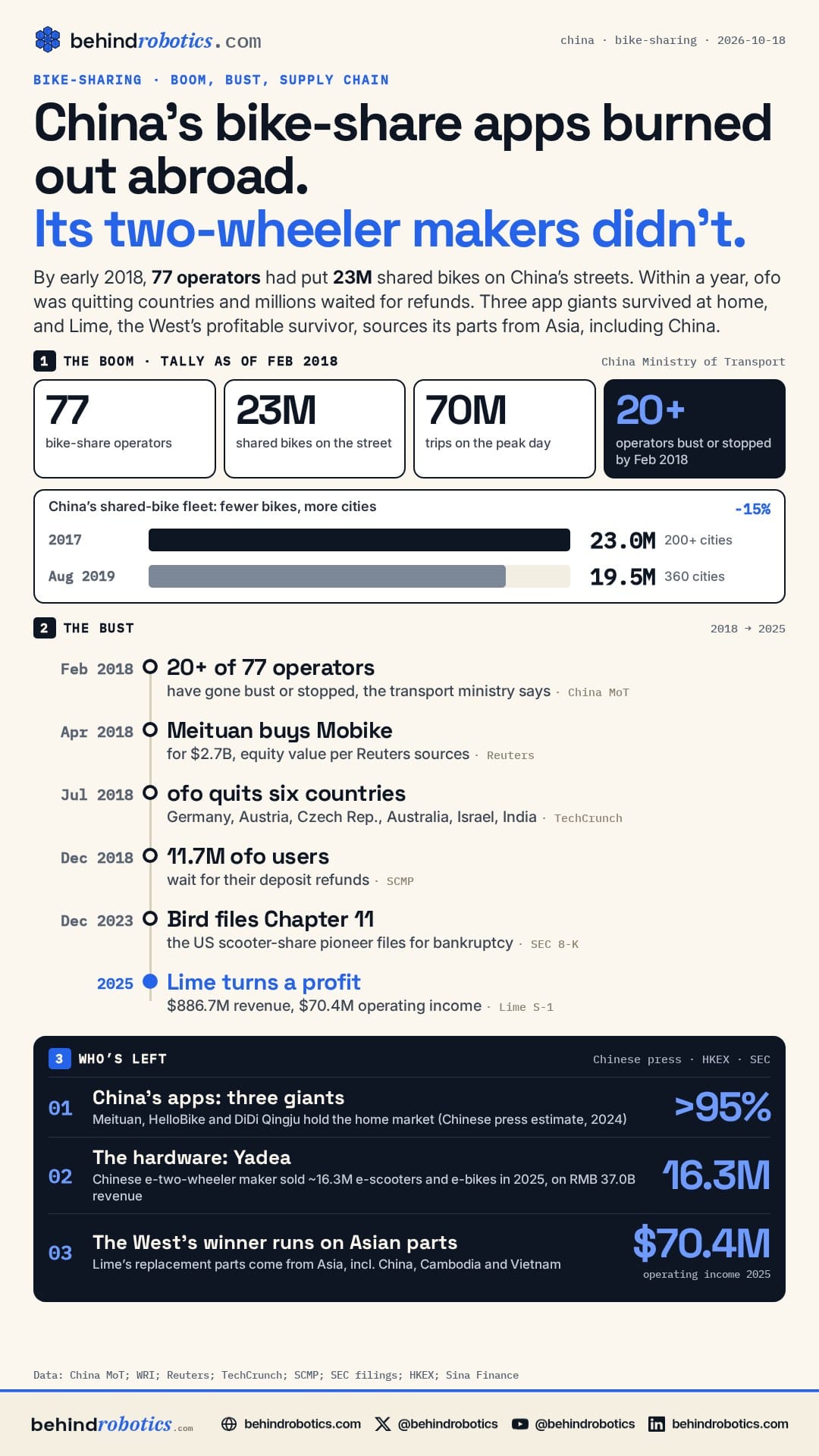
If DiDi shows the upside of China's playbook, bike-sharing shows the cost. By the end of 2017, 77 companies had put 23 million shared bikes on Chinese streets. China's vice minister of transport said they had carried 17 billion trips, with a peak of 70 million in a single day. By February 2018, more than 20 of the 77 had already collapsed.
ofo raised about $2.2 billion, ran more than 10 million bikes in 20 countries and was valued above $2 billion. In mid-2018 it pulled out of Germany, Austria, the Czech Republic, Australia, Israel and India, and laid off most of its US staff. Mobike, sold to Meituan for $2.7 billion in April 2018, left Manchester over theft and vandalism. By December 2018, 11.7 million ofo users were waiting for deposit refunds. By 2020 the queue passed 15 million. China's fleet shrank to 19.5 million bikes, even as service spread to 360 cities.
The survivors? Meituan, HelloBike and DiDi's Qingju now hold more than 95% of the market by Chinese press counts. Abroad, the ofo–Mobike invasion mostly failed. Bird went bankrupt in December 2023. Lime made it: $886.7 million of 2025 revenue, an operating profit, and a Nasdaq listing this year.
But look at what Lime's own IPO filing says about where its parts come from: Asia, "including China, Cambodia, and Vietnam." China's bike-share apps burned out abroad. Its two-wheeler makers didn't. Yadea alone sold about 16.3 million electric two-wheelers in 2025 on RMB 37 billion of revenue.
That is the robotics forecast hiding in plain sight. Even where Western operators and integrators keep the customer, the actuators, reducers, frames and, more and more, the whole robot may still be Chinese. It is also the warning. Overbuilt capacity and price wars can wipe out a whole layer of companies even while the category booms.
Lesson three: EVs and the great displacement
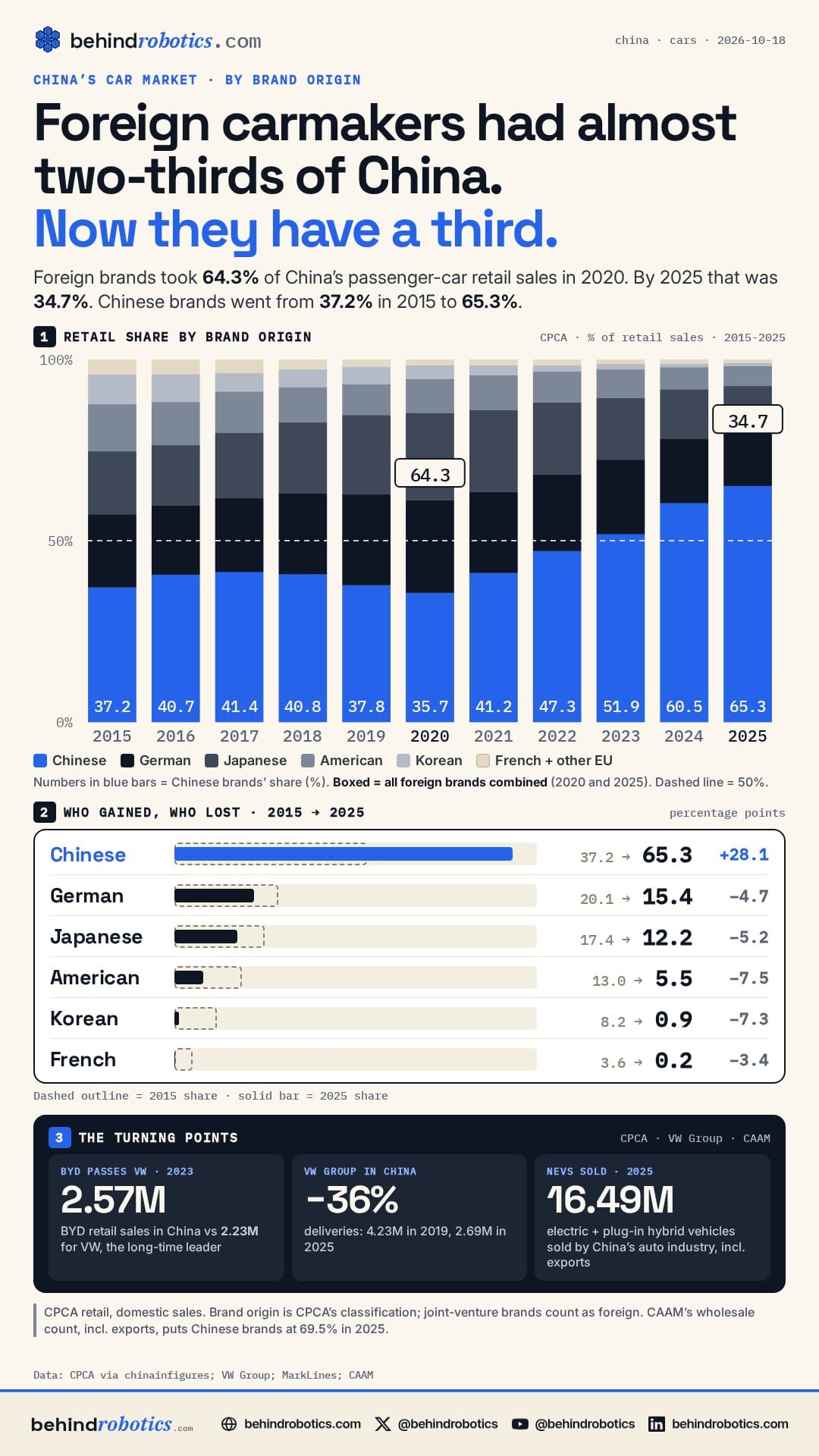
The EV story is the one the West keeps telling itself it understands. In 2011 Bosch's automotive chief Bernd Bohr called EV technology "embryonic" and warned against "E-Hype." In 2025 China sold 16.49 million new-energy vehicles, more than half of all new cars sold at home, and exported 2.615 million of them.
The share chart is brutal. Under the China Passenger Car Association's retail measure, foreign-origin brands held about 64% of China's passenger-car market in 2020. In 2025 they held about 35%. German brands fell from 25.5% to 15.4%, and Japanese brands halved from 24.1% to 12.2%. BYD outsold Volkswagen in 2023 and ended VW's 15-year run as China's top brand. VW Group delivered 4.23 million vehicles in China in 2019. In 2025 it delivered 2.69 million, down about 36%.
Then came the closures. Honda shut a GAC Honda plant, paused a Dongfeng Honda plant and cut its China capacity from 1.49 million to 1.2 million. About 1,700 workers took voluntary exits, and Honda's 2025 China sales fell another 24%. GM booked more than $5 billion in China charges. Nissan stopped production in Changzhou.
The foreign carmakers did not lose China for lack of engineering. They lost a domestic supply chain built around batteries and electric drives at a speed and cost they could not match. Here the robotics link is literal. AgiBot says it scaled humanoids on the NEV supply chain's motors and gearboxes. Chinese robot makers already hold 90% of their home market in metal and machinery. In automotive, where reliability and process risk drive the buying decision, they hold just 31%. That's the trust gap, and it is where the next fight happens.
How the déjà vu plays out in robots and embodied AI
Here is our read. We label it as such because it's a forecast, not a fact.
1. Hardware is already following the EV price curve. Unitree launched its G1 humanoid at ¥99,000 in 2024. A year later its R1 came out at ¥39,900, about $5,900. On the industrial side, GGII-cited prices for SCARA arms fell to about ¥10,000, roughly half the year before, and 6-kg six-axis arms sell just above ¥20,000. When the base price of a capable arm falls under the cost of a few months of labor, the buyer's question changes from "is it good enough?" to "why not ten?"
2. Units in the field become training data. Embodied AI runs on robot hours. Unitree shipped 5,511 humanoids in 2025, according to its STAR Market prospectus. Omdia estimates AgiBot shipped 5,168. Every one of those is a data collector. AgiBot World, the open dataset AgiBot released with OpenDriveLab, already holds 1,001,552 trajectories from more than 100 robots across 217 tasks. Tesla, by comparison, reportedly has more than 500,000 hours of Optimus training data, yet most of its robots are still used internally for testing and data collection, according to The Information. Fleet size is a flywheel, and China is building fleets faster.
3. Open models commoditize the brain, and that helps whoever ships the body. It isn't only China giving models away. Unitree open-sourced its UnifoLM world-model-action weights. Physical Intelligence publishes π0 and π0.5 base checkpoints trained on more than 10,000 hours of robot data. NVIDIA's GR00T N1.7 is open under Apache 2.0. When good base policies are free, the scarce inputs are cheap, reliable hardware and deployment-specific data. On the CIIF floor, those looked like China's strengths.
4. The West's real lead is the frontier, not the fleet. Figure says its F.02 loaded more than 90,000 parts and helped build more than 30,000 BMW X3s. Physical Intelligence and NVIDIA set much of the research agenda. Tesla is reported to be building hundreds of Optimus units a week. The risk for the West is the EV pattern exactly: owning the best demo while someone else owns the cost curve. The way out is to turn model leadership into deployed units before Chinese hardware gets good enough.
The counterpoints are real. Chinese makers hold only 31% of China's own automotive robot market. Statista's 2023 value ranking has no Chinese brand in the top nine: Japanese makers hold 44% and European makers 24%. One of those "European" titans, KUKA, has been majority-owned by China's Midea since 2016. Precision, uptime, global service networks and safety certification still favor the incumbents. Chinese margins are also burning. SIASUN's industrial-robot revenue fell 46% in the first half of 2025 as prices kept dropping. "More units, less money," one industry executive told Jiemian. ofo is the reminder that volume without economics can end in a refund queue.
The export turn
The customs data says the déjà vu has left China's borders. China's industrial-robot exports grew 48% in 2025 to about $1.67 billion, against $1.38 billion of imports. That made China a net exporter of industrial robots for the first time, which China's customs administration (GACC) confirmed at the State Council briefing in January. GACC also said exports of industrial robots to Europe grew by more than 20%. Growth has since cooled to +17.5% for January to August 2026, with the surplus still intact.
Since January, China has also tracked a new customs line for "intelligent bionic robots," which covers humanoids and robot dogs together. From January to August, China exported 14,458 of them, worth ¥1.168 billion (about $164.5 million). Through July, the US was the top destination by value. Germany tops the overall robot export table this year, but cleaning robots drive that, at 70% of all robot exports. On a like-for-like basis, Vietnam is the biggest buyer and Germany is seventh.
The answer Europe will reach for: tariffs
When imports bite, Brussels has a template. On October 30, 2024, the EU imposed five-year countervailing duties on Chinese battery-electric cars: 35.3% on SAIC, 18.8% on Geely, 17.0% on BYD and 7.8% on Tesla's Shanghai output, all on top of the standard 10% car duty. In January 2026 the Commission published guidance for minimum-price undertakings, a way to swap tariffs for price floors.
Robots aren't there yet. As of this week we found no EU anti-dumping or anti-subsidy case on Chinese robots. The Commission's in-depth Foreign Subsidies Regulation probes target Chinese wind turbines (Goldwind) and security scanners (Nuctech). The Industrial Accelerator Act, proposed on March 4, 2026, adds "Made in EU" rules to public procurement and support schemes. It covers vehicles, batteries, net-zero tech and basic materials, and does not name robots. Europe's machinery lobby is pushing back. "Local content is rarely the solution," said VDMA executive director Thilo Brodtmann. He argues that Buy European rules belong only where security is at stake.
Washington is further along. In September 2025 the Commerce Department opened a Section 232 national-security investigation into robotics and industrial machinery. It explicitly asks about "state-sponsored overproduction" and "artificially suppressed prices." As of October 2026 no duty has been imposed. But the drone case shows the path: Section 232 duties on drones have applied since September 3.
Our read: protection is coming, probably first in the US and later in the EU through the FSR, procurement rules, or a trade-defense case if Chinese arms start winning European tenders. But the EV precedent argues against relying on it. Tariffs did nothing for foreign carmakers' share inside China, which fell from roughly 64% to 35% anyway. And Europe's factories need cheap automation more than its robot makers need protection. A 35% duty on a ¥23,800 arm still leaves a cheap arm.
What to watch
- Automotive share. If Chinese suppliers move from 31% of China's automotive robot installs toward 50%, the trust gap is closing.
- Export mix. Watch whether industrial-robot exports re-accelerate from +17.5%, and whether Germany climbs the like-for-like table.
- Bionic-robot customs line. Watch whether monthly humanoid and robot-dog exports keep rising, and whether the US stays the top buyer once tariffs land.
- Margins. If price-war losses spread beyond SIASUN and EFORT, an ofo-style shakeout is likely before any global win.
- Western units. We want published unit totals from Figure, NEURA, Tesla and Agility, not capacity targets.
- The tariff trigger. Two events to watch: a US Section 232 robotics proclamation, and the first EU FSR or anti-dumping case naming a Chinese robot maker. When either lands, the EV decade will have officially reached robotics. Then the question becomes whether Europe protects its robot makers or its factories.
Related: Those who deliver, win. · Chinese makers accounted for more than 97% of global humanoid shipments in H1 2026
Footage and photos: behindrobotics at CIIF 2026, Shanghai. Sources: see research notes; every number is linked in the published version.
Every number links to its source. Forecast paragraphs are labelled as our read. behindrobotics did not receive payment or products from any company named. Full research notes: ciif-parallels-2026-10-18.